
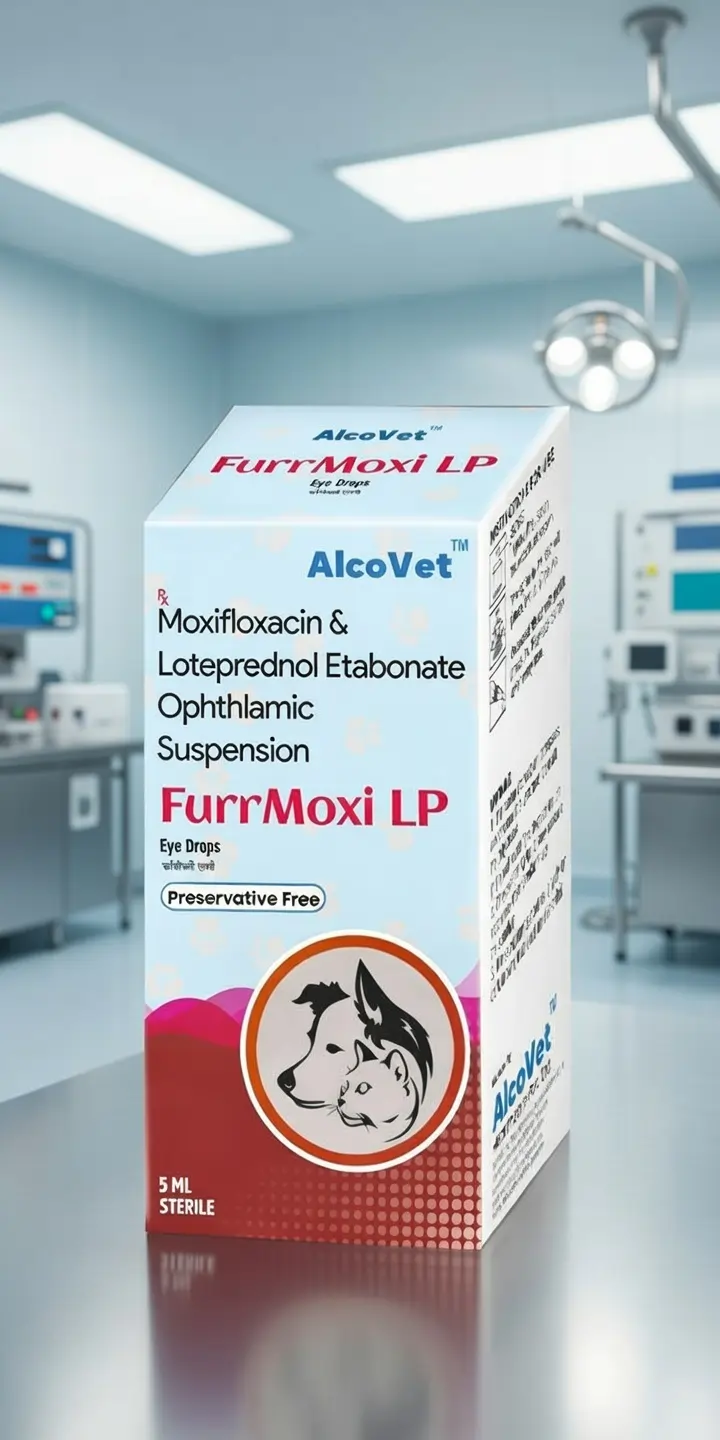
FurrMoxi LP
Preservative-Free Post-Operative Ophthalmic Suspension for Dogs & Cats
Overview & Clinical Rationale
Post-operative ocular care demands simultaneous control of two independent risks: surgical site infection and post-surgical inflammation. Deploying separate antibiotic and steroid preparations introduces complexity, increases the burden of dosing schedules, and — critically — doubles the patient's exposure to topical preservatives. FurrMoxi LP addresses this clinical challenge with a single, preservative-free suspension combining two precisely chosen active agents.
Moxifloxacin HCl 0.5% — a 4th-generation fluoroquinolone — delivers broad-spectrum bactericidal activity with superior ocular penetration compared to earlier fluoroquinolone generations. Loteprednol Etabonate 0.5% — a site-active ester corticosteroid — provides potent local anti-inflammatory action with a substantially safer intraocular pressure (IOP) profile versus prednisolone acetate or dexamethasone, owing to its rapid metabolic inactivation upon systemic absorption.
Why Preservative-Free Matters Post-Operatively
Benzalkonium chloride (BAK), present in most multi-dose ophthalmic preparations, disrupts the lipid tear film, damages corneal epithelial cells and goblet cells, and impairs wound healing — risks that are unacceptable on a compromised post-surgical ocular surface. FurrMoxi LP eliminates this chemical stress entirely.
Part of the AlcoVet Eye Care Portfolio
FurrMoxi LP anchors the post-operative phase of AlcoVet's ocular care pathway. It is often combined with Vet Tears HA for complete peri-operative surface protection.
Key Ingredients & Mechanisms
Moxifloxacin HCl 0.5%
4th-generation fluoroquinolone. Inhibits bacterial DNA gyrase (topoisomerase II) and topoisomerase IV — dual-target bactericidal action that prevents bacterial DNA replication and repair. Superior Gram-positive, Gram-negative, and atypical pathogen coverage compared to 2nd/3rd generation agents, with enhanced corneal and aqueous humour penetration.
Loteprednol Etabonate 0.5%
Site-active ester corticosteroid. Binds glucocorticoid receptors, suppressing prostaglandins, leukotrienes, and inflammatory cytokines in ocular tissues. Metabolised to inactive metabolites upon systemic absorption — reducing systemic steroid exposure and lowering risk of IOP elevation versus ketone-based steroids such as prednisolone or dexamethasone.
Preservative-Free Base
Formulated without benzalkonium chloride (BAK) or other preservatives. Removes the principal source of iatrogenic epithelial toxicity in post-operative eyes. Supports faster, healthier corneal wound healing without additional chemical stress to the compromised ocular surface.
Dual-Action Synergy
Moxifloxacin and loteprednol address both pillars of post-operative ocular risk in a single drop — simultaneous prophylaxis against surgical site pathogens and control of the inflammatory cascade. One formulation, one preservative exposure (none), one dosing schedule.
Indications
FurrMoxi LP is indicated for use under specialist veterinary supervision in the following post-operative and specialist-managed scenarios:
- Post-cataract surgery & phacoemulsification — prophylaxis against bacterial infection and control of surgical inflammation
- Third-eyelid (cherry eye) replacement surgery — infection prophylaxis and reduction of post-surgical conjunctival inflammation
- Entropion/ectropion correction — adnexal surgical procedures with infection risk and lid margin inflammation
- Conjunctival grafting & surface surgeries — post-operative antimicrobial and anti-inflammatory cover
- Specialist-supervised inflammatory management — non-infectious, non-ulcerative anterior uveitis or scleritis under confirmed diagnosis where concurrent infection risk is present
Critical Contraindication — Corneal Ulceration
Do NOT use FurrMoxi LP in any eye with active or suspected corneal ulceration. Topical corticosteroids delay epithelial healing, promote stromal collagenolysis and can precipitate corneal perforation. Always confirm corneal integrity with fluorescein staining before initiating treatment. If an ulcer develops during therapy, discontinue immediately.
Dosing & Administration
All protocols below are indicative. Adjust frequency, taper rate and duration based on individual patient response, surgical complexity and veterinary assessment. The suspension must be shaken well before each use.
| Phase | Timing | Frequency | Notes |
|---|---|---|---|
| Acute | Days 1–3 | 4× daily (q6h) | Initiate on day of surgery or Day 1 post-op |
| Taper 1 | Days 4–7 | 3× daily | Monitor for early signs of inflammation resolution |
| Taper 2 | Week 2 | 2× daily | Continue if inflammation persists; IOP check if >10 days |
| Discontinue | Day 14+ | As directed | Typically discontinue at 2 weeks; taper further if required |
- Shake well before each instillation — suspension formulation
- Wait 5–10 minutes between different ophthalmic medications; instil FurrMoxi LP before lubricant drops such as Vet Tears HA
- Avoid touching the dropper tip to the eye, eyelids or any surface
- Store at 15–25°C; keep tightly closed when not in use
- Discard 4 weeks after opening to maintain sterility
Combination Drop Sequence
When used concurrently with Vet Tears HA: instil FurrMoxi LP first, wait 5–10 minutes, then instil Vet Tears HA. This sequence ensures the antimicrobial suspension achieves adequate contact time before the viscoelastic lubricant is applied.
Safety, Monitoring & Precautions
Absolute Contraindications
Active corneal ulceration or epithelial defect (fluorescein-positive) • Fungal keratitis or mycobacterial ocular infection • Viral keratitis (herpesvirus) • Known hypersensitivity to fluoroquinolones or corticosteroids.
- Corneal integrity baseline: Perform fluorescein staining before treatment and at any follow-up visit if corneal ulceration is suspected
- IOP monitoring: If therapy extends beyond 10 days, measure intraocular pressure — even with loteprednol's safer IOP profile
- Secondary infection surveillance: Prolonged corticosteroid use can unmask or promote fungal, resistant bacterial, or opportunistic infections — reassess if signs worsen or fail to resolve
- 48–72 hour response check: If no clinical improvement is observed within 48–72 hours, reassess diagnosis, obtain culture/sensitivity where indicated, and evaluate for surgical complications
- Not for empiric or OTC use: Requires confirmed post-operative or specialist diagnosis — must not be used without prior examination and direct veterinary supervision
Potential Adverse Effects
Transient stinging or mild discomfort on instillation • Delayed wound healing with prolonged steroid use • IOP elevation (less common with loteprednol vs ketone steroids) • Secondary fungal or resistant bacterial infection (rare, with extended use) • Contact allergy to formulation components (rare).
Combination Therapy & Outcome Timeline
Paired with Vet Tears HA
FurrMoxi LP provides antimicrobial and anti-inflammatory cover; Vet Tears HA provides high-molecular-weight sodium hyaluronate lubrication and tear-film stabilisation. The combination is particularly valuable after third-eyelid (cherry eye) surgery, where the procedure may transiently reduce natural tear production. Learn more about Vet Tears HA →
Sample Post-Cataract Surgery Protocol:
- Day 0 (Surgery): FurrMoxi LP 4× daily + Vet Tears HA 4× daily
- Days 1–7: Continue both 4× daily; assess inflammation at Day 3–5
- Days 8–14: Taper FurrMoxi LP to 2× daily; maintain Vet Tears HA 3–4× daily
- Week 3+: Discontinue FurrMoxi LP if inflammation resolved; continue Vet Tears HA as needed for surface support
Expected Clinical Outcome Timeline:
24–48 Hours
Initial reduction in ocular discomfort; early decrease in conjunctival hyperemia and discharge
Days 3–5
Significant improvement in clinical signs; corneal clarity improving; inflammation reducing measurably
Week 1–2
Continued resolution of inflammation; epithelial healing progressing; tapering toward discontinuation
No Improvement by 72 Hours
Reassess diagnosis urgently. Consider culture/sensitivity testing, evaluate for surgical complications, consult a veterinary ophthalmologist
Composition & Pack Information
| Active Ingredients | Moxifloxacin HCl eq. to Moxifloxacin 0.5% w/v & Loteprednol Etabonate 0.5% w/v |
|---|---|
| Formulation | Preservative-free sterile ophthalmic suspension |
| Route | Topical ophthalmic — instil directly into conjunctival sac |
| Target Species | Dogs & Cats |
| Pack Size | 5 mL multi-dose bottle |
| Storage | 15–25°C; protect from light; keep tightly closed |
| In-use Stability | Discard 4 weeks after first opening |
| Availability | Specialist veterinary channel only — prescription required |
| Full Monograph | Complete dosing by species/weight, excipient list and stability data available on request. Download here |
Frequently Asked Questions
How long can FurrMoxi LP be used safely?
Can FurrMoxi LP be used in cats?
What if the patient develops a corneal ulcer during treatment?
Why is preservative-free important for post-operative ocular care?
Can FurrMoxi LP be used for routine conjunctivitis?
Selected References
References support the scientific basis of this formulation. They do not constitute clinical recommendations. All therapeutic decisions should be made by a qualified veterinarian.
- 1Gelatt KN, Gilger BC, Kern TJ, eds. Veterinary Ophthalmology, 5th ed. Wiley-Blackwell; 2013.
- 2Comstock TL, Decory HH. Advances in corticosteroid therapy for ocular inflammation: loteprednol etabonate. Int J Inflam. 2012;2012:789623. doi:10.1155/2012/789623
- 3Moshirfar M, et al. Fourth-generation fluoroquinolones in ophthalmology. Expert Opin Pharmacother. 2007;8(11):1679–1691. doi:10.1517/14656566.8.11.1679
- 4 Baudouin C, Labbé A, Liang H, et al. Preservatives in eyedrops: the good, the bad and the ugly. Prog Retin Eye Res. 2010;29(4):312-334. doi:10.1016/j.preteyeres.2010.03.001 Comprehensive review detailing the toxicity of Benzalkonium Chloride (BAK) on the corneal epithelium and tear film, validating the need for preservative-free formulations post-surgery.
- 5 Ilyas H, Slonim CB, Braswell GR, et al. Long-term safety of loteprednol etabonate 0.5% in the treatment of ophthalmic inflammatory diseases. Ophthalmology. 2004;111(8):1619-1621. doi:10.1016/j.ophtha.2003.12.056 Clinical evidence supporting the reduced risk of intraocular pressure (IOP) elevation with ester-based corticosteroids compared to traditional ketone steroids.
FurrMoxi LP is part of AlcoVet's Eye Care portfolio. Pair with Vet Tears HA for complete peri-operative ocular surface protection.