
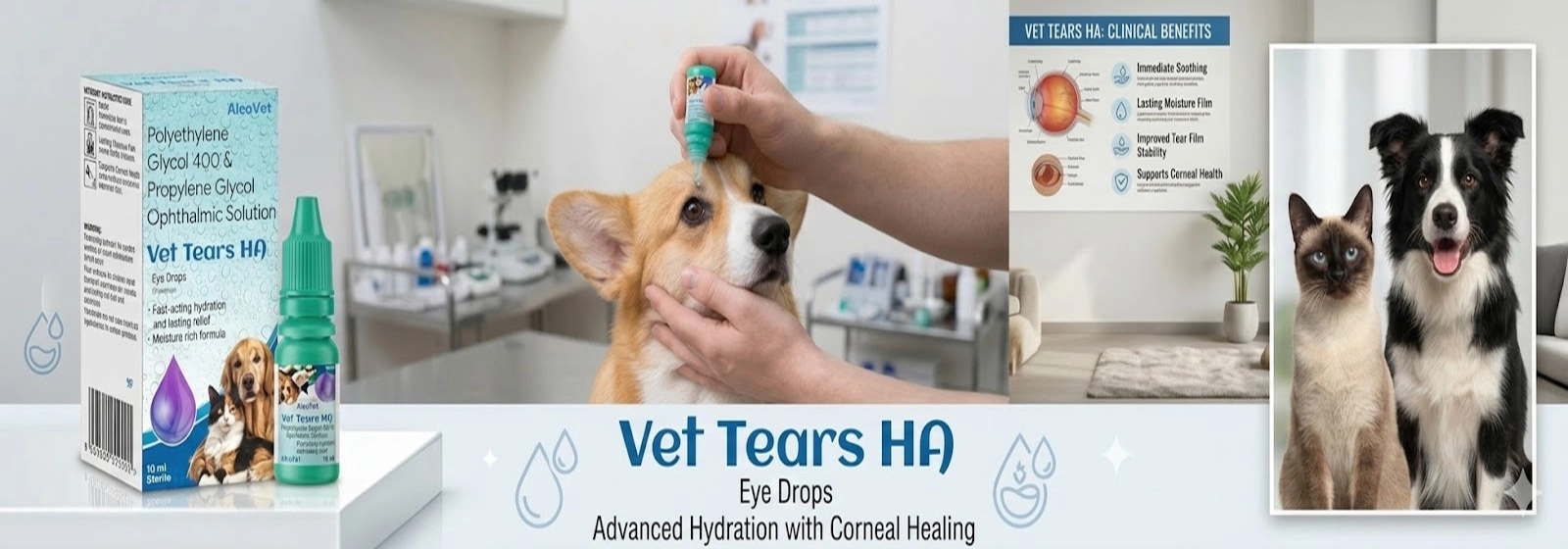
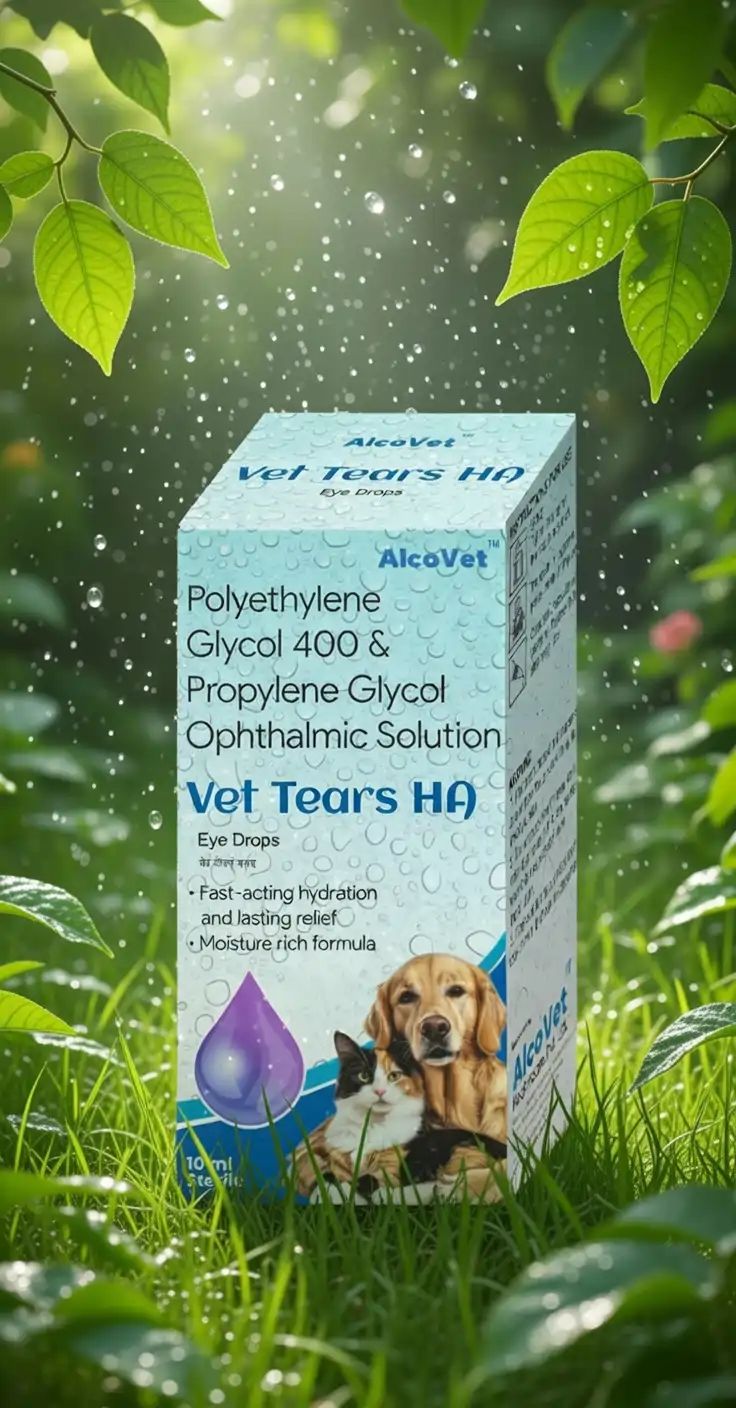
Vet Tears HA
Sodium Hyaluronate Ocular Lubricant for Dogs & Cats
A viscoelastic multi-component ophthalmic lubricant formulated with Sodium Hyaluronate, HP Guar adaptive technology and rapid-acting demulcents — delivering multi-layer tear-film stabilisation, sustained corneal hydration and epithelial healing support for canine and feline patients.
Overview & Clinical Rationale
The precorneal tear film is a complex trilaminar structure. In dogs and cats, disruption of this film — through immune-mediated lacrimal disease (KCS), surgical intervention, neurological dysfunction or environmental exposure — leads to corneal desiccation, epithelial breakdown and progressive visual compromise. Inadequate lubrication also predisposes to secondary infection and chronic inflammation.
Vet Tears HA is engineered to replicate and supplement the natural tear film through three synergistic mechanisms: the viscoelastic mucoadhesive polymer sodium hyaluronate, the adaptive HP Guar gel-forming matrix, and rapid-acting demulcents (PEG 400, Propylene Glycol) — together providing immediate comfort, extended residence time and active epithelial support in a single formulation.
Multi-Layer Protection in a Single Drop
Unlike single-agent lubricants, Vet Tears HA addresses all three tear-film layers simultaneously: immediate humectant relief (PEG 400, Propylene Glycol), sustained mucoadhesive retention (Sodium Hyaluronate) and adaptive gel-matrix bridging (HP Guar) — making it suitable for both acute and chronic ophthalmic presentations.
Key Ingredients & Mechanisms
Sodium Hyaluronate
A high-molecular-weight viscoelastic glycosaminoglycan with powerful mucoadhesive and water-binding properties — each molecule retains up to 1,000× its weight in water. Binds directly to corneal epithelium forming a sustained lubricating film, promotes epithelial cell migration across defects and significantly extends tear contact time compared to basic artificial tears.
HP Guar — Adaptive Technology
Hydroxypropyl Guar undergoes ionic cross-linking with tear film electrolytes (Na⁺, K⁺) immediately on contact, forming a soft protective gel matrix. This unique mechanism extends residence time beyond HA alone while maintaining visual clarity — bridging the gap between rapid-onset demulcent relief and the long-duration HA layer.
PEG 400 & Propylene Glycol
Humectant demulcents providing rapid moisture attraction and retention immediately on instillation. Reduce mechanical lid-cornea friction during blinking and deliver instant comfort relief — working synergistically with HA for a dual-onset, dual-duration lubrication profile.
Sodium Oxychloro Complex
A vanishing preservative providing in-bottle antimicrobial sterility for multi-dose use. Converts to water, oxygen and sodium chloride within seconds of ocular surface contact — eliminating BAK-associated epithelial toxicity and goblet cell damage. Safe for chronic long-term use without cumulative preservative load.
Indications
Vet Tears HA is indicated for ocular surface lubrication and tear-film support across the following clinical presentations:
- Keratoconjunctivitis sicca (KCS) — chronic and recurrent; as monotherapy in mild cases and adjunct to immunomodulators in moderate-to-severe disease
- Post-cherry eye (third eyelid gland) surgery — restores tear-film stability following gland-preserving pocket procedures where temporary lacrimal output reduction is expected
- Post-cataract surgery — ocular surface lubrication during the recovery phase; used as last drop in the post-op regimen
- Corneal epithelial defects and keratitis — supports epithelial cell migration and reduces friction across healing corneal surfaces
- Exposure and pigmentary keratitis — adjunct management in brachycephalic and other predisposed breeds
- Adjunct to cyclosporine or tacrolimus therapy — symptomatic lubrication while immunomodulators act over 4–8 weeks
- General ocular surface comfort — environmental irritants, dust, wind exposure; perioperative eye protection
Clinical Note — Third Eyelid Gland
The nictitating membrane gland contributes 30–50% of aqueous tear production. Even successful gland-preserving surgery may temporarily reduce Schirmer values. Vet Tears HA bridges this deficit during healing and supports long-term outcomes in patients with residual tear deficiency post-operatively.
Dosing & Administration
1 drop per affected eye per instillation. Frequency is adjusted by clinical severity and the phase of treatment:
| Indication / Phase | Frequency | Notes |
|---|---|---|
| KCS Mild STT 10–15 mm | 2–3× daily | May be used as sole lubricant if STT improving |
| KCS Moderate STT 5–9 mm | 4–5× daily | Combine with cyclosporine or tacrolimus |
| KCS Severe STT <5 mm | Every 2–3 h (up to 6×) | Immunomodulator essential; monitor STT every 2 weeks |
| Post-Cherry Eye W1 | 6–8× daily | Every 2–3 h in first week post-op |
| Post-Cherry Eye W2–4 | 4–6× daily | Taper based on STT at 2-week recheck |
| Post-Cherry Eye W4–8 | 3–4× daily | Continue long-term if STT remains below normal |
| Post-Cataract D0–7 | 4× daily | Apply after FurrMoxi LP (wait 5–10 min); last drop always |
| Corneal Healing | 4–6× daily | Taper to 2–3× after epithelial closure |
Administration Guidelines
- Tilt head gently; pull lower eyelid to form a pocket; instil one drop into lower fornix
- Do not allow dropper tip to contact the eye, eyelid or any surface
- Multiple medications: always apply medicated drops first; Vet Tears HA is always the last drop — wait 5–10 min between products
- Store at room temperature (15-25 degrees C). Do not freeze. Keep bottle tightly closed when not in use.
- Discard 90 days after first opening; do not share between patients
Safety & Precautions
- No absolute contraindications — generally safe for all canine and feline patients of any age, including puppies and kittens
- Vanishing preservative suitable for long-term chronic use without cumulative toxicity
- Compatible with antibiotics, anti-inflammatories and immunomodulators (apply medicated drops first; wait 5–10 min before Vet Tears HA)
- Monitoring: Schirmer Tear Test every 2–4 weeks in KCS; fluorescein staining to assess epithelial healing in ulcerative cases
Precautions & Adverse Effects
- Hypersensitivity (rare): discontinue and reassess if worsening redness, discharge or blepharospasm develop
- Transient mild stinging on instillation — resolves within seconds; not a reason to discontinue unless persistent
- Temporary mild blurring immediately after application — lasts 1–2 minutes, normal with viscoelastic formulations
- Active infection: not contraindicated but ensure appropriate concurrent antimicrobial therapy is in place
- If no improvement after 2 weeks of appropriate use, re-evaluate diagnosis — consider underlying systemic causes and specialist referral
Composition & Pack Information
| Active Ingredients | Sodium Hyaluronate, Polyethylene Glycol 400, Propylene Glycol, Hydroxypropyl Guar (HP Guar), Sodium Oxychloro Complex |
|---|---|
| Formulation | Sterile viscoelastic ophthalmic solution |
| Route | Topical ophthalmic (eye drops) |
| Target Species | Dogs & Cats |
| Pack Size | 10 mL multi-dose ophthalmic bottle |
| Preservative | Sodium Oxychloro Complex (vanishing — converts to H₂O + O₂ + NaCl on contact) |
| Storage | Store at room temperature (15-25 degrees C). Do not freeze. Keep bottle tightly closed when not in use. |
| In-Use Shelf Life | Discard 90 days after first opening |
| Availability | Veterinary channel — prescription recommended for protocol use |
| Full Monograph | Detailed excipient list, pH, osmolality and stability data available on request. Download here |
Clinical Integration
Vet Tears HA is most effective when integrated into a complete ocular therapy protocol. In post-surgical cases, it pairs directly with FurrMoxi LP (antibiotic-steroid combination) for comprehensive recovery management.
Drop Sequence — Multi-Medication Protocol
When combining with FurrMoxi LP or other ophthalmic medications, strict sequencing ensures maximum bioavailability of each product:
Expected Outcomes & Timeline
-
MinutesImproved comfort; reduced blepharospasm on instillation
-
1–3 DaysReduced ocular discharge; decreased conjunctival hyperaemia
-
1–2 WeeksImproved corneal clarity; reduced pigmentation progression
-
4–8 WeeksMeasurable STT improvement when combined with immunomodulator
-
No Response @ 2 WeeksRe-evaluate diagnosis; confirm compliance; consider underlying systemic causes or specialist referral
FurrMoxi LP
Preservative-free antibiotic–steroid ophthalmic suspension for post-operative infection prophylaxis and inflammation control in dogs and cats. Paired with Vet Tears HA for complete post-surgical eye care.
View FurrMoxi LPFrequently Asked Questions
How long can Vet Tears HA be used safely?
Can Vet Tears HA be used in cats?
What is the difference between Vet Tears HA and basic artificial tears?
Selected References
References support the scientific basis of this formulation. They do not constitute clinical recommendations. All therapeutic decisions should be made by a qualified veterinary practitioner.
- 1 Gelatt KN, Gilger BC, Kern TJ, eds. Veterinary Ophthalmology. 6th ed. Wiley-Blackwell; 2021. Authoritative veterinary ophthalmology reference — KCS, corneal disease, ophthalmic pharmacology
- 2 Williams DL, Mann BK. Efficacy of a Crosslinked Hyaluronic Acid-Based Hydrogel as a Tear Film Supplement: A Masked Controlled Study. PLoS ONE. 2014;9(6):e99766. doi:10.1371 Demonstrates the efficacy of hyaluronic acid in reducing clinical signs of canine keratoconjunctivitis sicca (KCS) and improving ocular surface health.
- 3 Araujo E, Galera PD. Effect of 0.15% sodium hyaluronate and 0.5% carboxymethylcellulose on tear film breakup time in healthy dogs and in dogs with keratoconjunctivitis sicca. Arq. Bras. Med. Vet. Zootec. 2018;70(5). Clinical evidence that sodium hyaluronate provides significantly longer tear film stability and retention on the ocular surface in dogs with KCS compared to standard cellulose derivatives.
- 4 Bedos L, et al. Precorneal retention time of ocular lubricants measured with fluorophotometry in healthy dogs. Vet Ophthalmol. 2023. Veterinary study validating the extended precorneal retention times of specific viscosity enhancers, including hydroxypropyl guar (HP Guar) formulations, in canine patients.
- 5 Ketelson HA, et al. Hydroxypropyl Guar−Borate Interactions with Tear Film Mucin and Lysozyme. Langmuir. 2005;21(25):11672–11677. Mechanistic study detailing the ionic cross-linking behavior of HP Guar and its adaptive gel-forming interaction with tear film components.
- 6 Gomes JAP, et al. Sodium hyaluronate promotes migration of human corneal epithelial cells in vitro. Br J Ophthalmol. 2004;88(6):821–825. PMC1772195 Evidence for HA actively promoting and accelerating corneal epithelial healing and cell migration across defects.
Vet Tears HA is part of AlcoVet's Eye Care portfolio. For post-operative antibiotic-steroid cover, see FurrMoxi LP.