
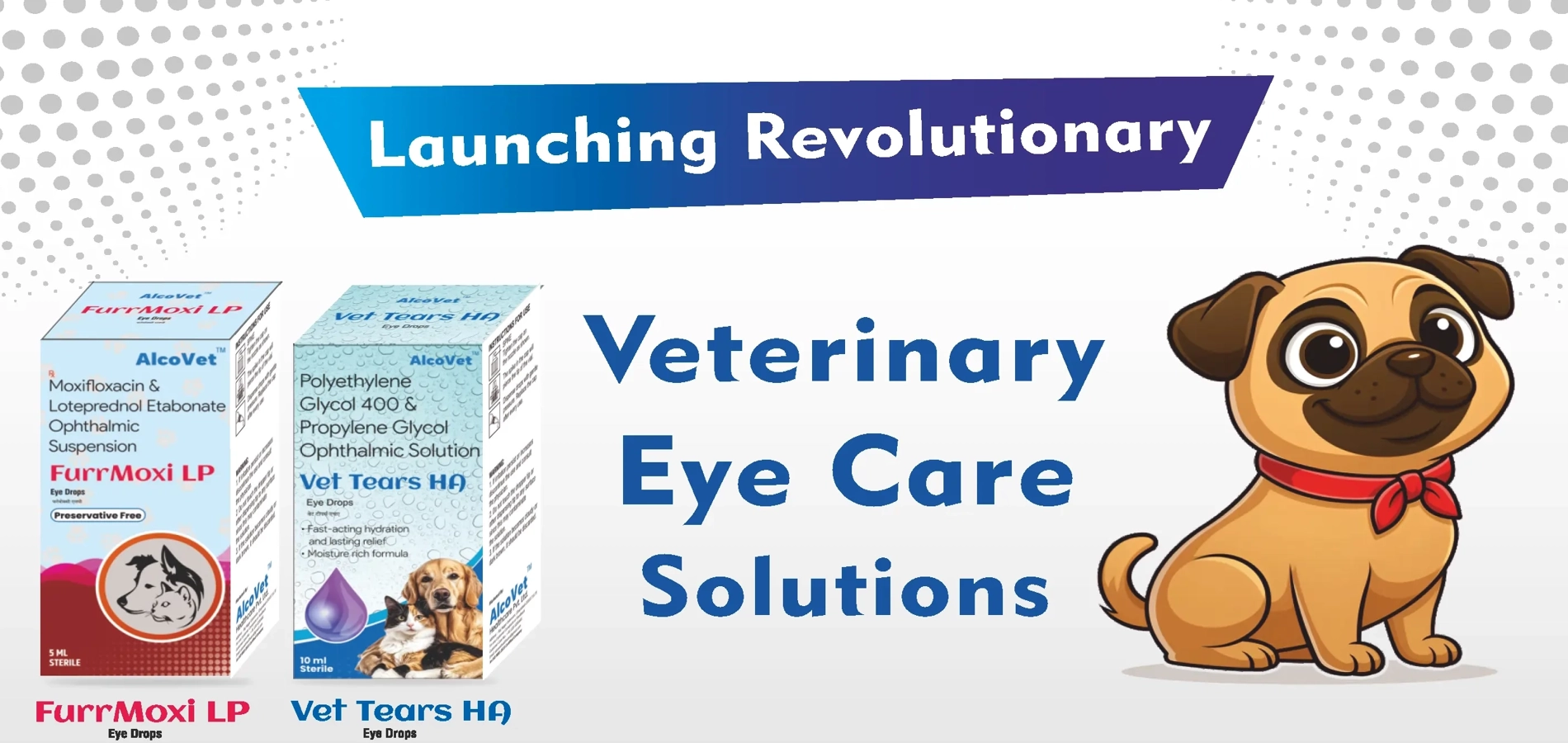
Eye Care Therapy Frameworks
Sample treatment frameworks illustrating how Vet Tears HA and FurrMoxi LP may be integrated into clinical practice for common ophthalmic conditions in dogs and cats.
Eye Care Products
Vet Tears HA
Viscoelastic Ocular Lubricant
Sodium hyaluronate-based ocular lubricant providing sustained corneal surface hydration, tear film stabilisation and epithelial healing support. Suitable for long-term use in chronic dry eye and post-surgical corneal surface protection.
- Chronic KCS — all severity grades
- Post-surgical corneal surface support
- Post-cherry eye surgery tear film compensation
- Corneal ulcer post-healing epithelial support
- Adjunct to immunomodulator therapy
- Exposure keratopathy — frequent lubrication
FurrMoxi LP
Preservative-Free Antibiotic Steroid
Preservative-free moxifloxacin and low-potency steroid combination for post-operative infection prophylaxis and ocular inflammation control. Designed for use where corneal integrity has been confirmed — never in active corneal ulceration.
- Post-cataract surgery acute inflammation control
- Post-cherry eye surgery perioperative inflammation
- Post-corneal surgery infection prophylaxis
- Bacterial conjunctivitis with inflammatory component
- NOT for active corneal ulceration — steroid contraindicated
Common Ophthalmic Conditions
Dry Eye (KCS)
Chronic tear deficiency — long-term lubrication and epithelial support with Vet Tears HA, with or without immunomodulator combination.
Full Condition GuidePost-Operative Care
Peri-operative management following cataract, corneal and adnexal procedures combining FurrMoxi LP and Vet Tears HA in sequence.
Full Condition GuideCherry Eye Surgery
Post-surgical management following third eyelid gland repositioning — compensating for potential tear production loss and managing inflammation.
Full Condition GuideProduct Selection Matrix
Quick reference — which product to use based on clinical scenario. Always confirm corneal integrity before prescribing FurrMoxi LP.
| Clinical Scenario | Products | Key Consideration |
|---|---|---|
| Chronic KCS / Dry Eye | Vet Tears HA | Long-term lubrication & epithelial healing; add immunomodulator for moderate–severe |
| Post-Cataract Surgery | FurrMoxi LP + Vet Tears HA | FurrMoxi LP first (anti-infective/anti-inflammatory), then Vet Tears HA 5–10 min later |
| Post-Cherry Eye Surgery | FurrMoxi LP + Vet Tears HA | Manage inflammation; compensate for potential 30–50% tear production loss |
| Active Corneal Ulcer | Vet Tears HA NOT FurrMoxi LP | Steroid component contraindicated in active ulceration — risk of worsening and perforation |
| Corneal Ulcer Post-Healing | Vet Tears HA | Confirm fluorescein-negative before transitioning to surface support only |
| Exposure Keratopathy | Vet Tears HA | Frequent application (up to Q2H) to prevent desiccation and secondary ulceration |
| KCS + Immunomodulators | Vet Tears HA | Adjunct to cyclosporine or tacrolimus — apply lubricant last in sequence |
| Bacterial Conjunctivitis | FurrMoxi LP | Confirm corneal integrity first; add Vet Tears HA if concurrent surface dryness |
Quick Decision Tree — FurrMoxi LP vs Vet Tears HA
Steroid contraindicated
Topical corticosteroids worsen active infections, delay epithelial healing, and significantly increase the risk of collagenase activation (corneal melting) and perforation.
Sample Treatment Frameworks
Framework 1 — Chronic KCS / Dry Eye
Step 1 — Initial Assessment
- Schirmer Tear Test (STT) — baseline measurement
- Fluorescein staining — confirm corneal integrity
- Rule out underlying cause: hypothyroidism, drug-induced, neurogenic
Step 2 — Dosing by STT Result
- Mild — STT 10–15mm
Vet Tears HA 1 drop 2–3× daily - Moderate — STT 5–9mm
Vet Tears HA 1 drop 4–5× daily + cyclosporine 0.2% BID - Severe — STT <5mm
Vet Tears HA Q2–3H (up to 6×) + immunomodulator
Monitoring Schedule
- Week 2: Recheck STT, adjust Vet Tears HA frequency
- Week 4–6: Assess immunomodulator response
- Month 2–3: Re-evaluate STT, transition to maintenance dosing
- Quarterly: Long-term STT + corneal exam
When to Refer
- STT remains <5mm after 8 weeks of optimised immunomodulator therapy
- Progressive corneal pigmentation despite treatment
- Suspected immune-mediated disease requiring systemic therapy
Framework for educational purposes. Individualise all dosing based on patient response, body weight, concurrent medications and clinical findings. Tags: Schirmer Tear Test, Lacrimal destroying, Immunomodulator.
Framework 2 — Post-Cataract Surgery
Day 0–7 — Acute Post-Op
- FurrMoxi LP 1 drop 4× daily
- Vet Tears HA 1 drop 4× daily — wait 10 min after FurrMoxi LP
- Monitor: infection signs, anterior chamber reaction, IOP
- E-collar mandatory throughout
Week 2 — Taper Begins
- Recheck IOP, corneal clarity, anterior chamber assessment
- FurrMoxi LP taper to 3× daily
- Vet Tears HA continue 3–4× daily
Week 3–4 — Continued Taper
- FurrMoxi LP taper to 2× daily; discontinue by Week 4
- Vet Tears HA taper to 2–3× daily, continue as needed for comfort
- Week 4 recheck — final post-op assessment
Red Flags — Refer Immediately
- Sudden vision loss
- Severe pain, blepharospasm or photophobia
- Hypopyon or marked anterior chamber flare
- IOP >25 mmHg
- Corneal oedema worsening after Day 3
Post-operative care should follow the operating surgeon's specific instructions. This is an educational framework only. Tags: Phacoemulsification, Intraocular Pressure, IOP, Inflammation.
Framework 3 — Post-Cherry Eye Surgery
Week 1 — Aggressive Lubrication Phase
- FurrMoxi LP 1 drop 3–4× daily
- Vet Tears HA 1 drop Q2–3H (up to 6–8× daily)
- Rationale: third eyelid gland contributes 30–50% of tear production — compensate for potential post-surgical loss
Week 2–4 — Assess Tear Production Recovery
- Week 2 STT — assess tear production status
- FurrMoxi LP taper based on inflammation — typically discontinue by Week 3
-
Vet Tears HA — adjust by STT:
STT >15mm → taper to 3–4×/day
STT 10–15mm → continue 4–5×/day
STT <10mm → continue 6×/day; consider immunomodulator
Long-Term Management Decision
- STT normalises (>15mm): Taper Vet Tears HA to PRN over 2–4 weeks
- STT remains low (<15mm): Continue Vet Tears HA 2–3× daily long-term
- Recheck schedule: Month 1, Month 3, then every 6 months
Risk Factors for Persistent Dry Eye
- KCS-predisposed breeds (Cocker Spaniel, Bulldog, Shih Tzu)
- Bilateral cherry eye surgery
- Gland excision vs. pocket/replacement technique
Post-surgical management varies by technique. Consult the operating surgeon for case-specific guidance. Tags: Third eyelid, Gland repositioning, Lacrimal recovery.
Framework 4 — Corneal Ulcer Post-Healing
Critical Contraindication
Do NOT use FurrMoxi LP (steroid-containing) in active corneal ulceration. This framework applies only after complete epithelial healing has been confirmed by fluorescein staining. Active ulcers require specialist-directed antimicrobial therapy only.
Step 1 — Confirm Epithelial Closure
- Fluorescein test negative — ulcer fully healed
- No signs of active infection or purulent discharge
- Corneal clarity improving on slit-lamp or examination
Step 2 — Post-Healing Support with Vet Tears HA
- Week 1–2 post-healing: Vet Tears HA 4–6× daily
- Week 3–4: Taper to 3–4× daily
- Maintenance: Continue 2–3× daily if underlying dry eye present
- If dry eye contributed to ulcer — manage long-term with Vet Tears HA + immunomodulator
Post-Ulcer Monitoring
- Recheck at 3–5 days, 2 weeks and 4 weeks post-healing
- Monitor: recurrence, corneal scarring, persistent discomfort
- If recurrent ulcers — investigate underlying cause (eyelid abnormality, neurogenic, breed predisposition)
Active corneal ulcers require specialist guidance. This framework is for the post-healing maintenance phase only. Tags: Epithelial healing, Fluorescein negative, Scarring.
Combination Therapy Application Sequence
When using both FurrMoxi LP and Vet Tears HA in the same session, sequence and timing matter. Applying the lubricant first can dilute or wash out the medicated drop before it has contact with the ocular surface.
Multiple Medications — Clinical Pearl
- For patients on 3 drops (e.g., FurrMoxi LP + cyclosporine + Vet Tears HA):
Most critical medication first — secondary medications — lubricant last - Always wait 5–10 minutes between different drops to prevent washout
- Vet Tears HA should always be the final drop in any multi-medication regimen to act as a sealing bandage.
Clinical Troubleshooting
Common challenges and practical solutions when patients do not respond as expected.
Patient Not Improving on Vet Tears HA
Possible Causes
- Insufficient dosing frequency — underdosing
- Underlying immune-mediated lacrimal destruction not addressed
- Owner compliance issues — incorrect instillation
- Misdiagnosis: exposure keratopathy, neurogenic dry eye
- Concurrent entropion or distichiasis causing ongoing irritation
Solutions
- Increase frequency to 5–6× daily if tolerated
- Initiate immunomodulator if not already prescribed
- Repeat STT; rule out other causes of ocular surface disease
- Demonstrate instillation technique to owner; assess compliance
- Refer to specialist if no improvement after 4–6 weeks of optimised therapy
Post-Op Inflammation Not Controlled
Possible Causes
- Inadequate FurrMoxi LP dosing frequency
- Severe baseline inflammation requiring stronger steroid
- Underlying bacterial or fungal infection not responding
- Patient rubbing despite E-collar
- Immune-mediated component — uveitis, scleritis
Solutions
- Consider increasing FurrMoxi LP to 5–6× daily short-term (specialist guidance)
- Culture if purulent discharge or worsening despite therapy
- Reinforce E-collar — ensure patient cannot access eye
- Consider systemic NSAIDs for severe inflammation (specialist decision)
- Refer immediately if no improvement within 48–72 hours or if worsening
Excessive Discharge Despite Treatment
Differential Diagnosis
- Bacterial conjunctivitis — may need different antimicrobial
- Blocked nasolacrimal duct causing epiphora
- Allergic component
- Foreign body (grass awn, hair) in conjunctival fornix
- Chronic irritation from eyelid abnormality: entropion, ectropion
Solutions
- Cytology and culture if bacterial cause suspected
- Nasolacrimal flush if duct obstruction suspected
- Thorough exam — evert lids, check fornices for foreign material
- Evaluate eyelid conformation; refer for surgical correction if indicated
- Consider antihistamine drops if allergic component suspected
Selected References
References support the scientific basis of these frameworks. All clinical decisions must be made by a qualified veterinary practitioner.
- 1 Berdoulay A, English RV, Nadelstein B. Effect of topical 0.02% tacrolimus aqueous suspension on tear production in dogs with keratoconjunctivitis sicca. Vet Ophthalmol. 2005;8(4):225–232. doi PMID 16008701
- 2 Moore CP. Diseases and surgery of the lacrimal secretory system. In: Gelatt KN, ed. Veterinary Ophthalmology. 4th ed. Blackwell Publishing; 2007:633–661.
- 3 Stiles J, Townsend WM. Feline ophthalmology. In: Gelatt KN, ed. Veterinary Ophthalmology. 4th ed. Blackwell Publishing; 2007:1095–1164.
- 4 Hendrix DVH. Diseases and surgery of the canine anterior uvea. In: Gelatt KN, ed. Veterinary Ophthalmology. 4th ed. Blackwell Publishing; 2007:812–858.
- 5 Startup FG. Corneal ulceration in the dog. J Small Anim Pract. 1984;25(12):737–752. doi
Interested in stocking Vet Tears HA or FurrMoxi LP?
Contact AlcoVet for clinic samples, product monographs and stockist enquiries.