
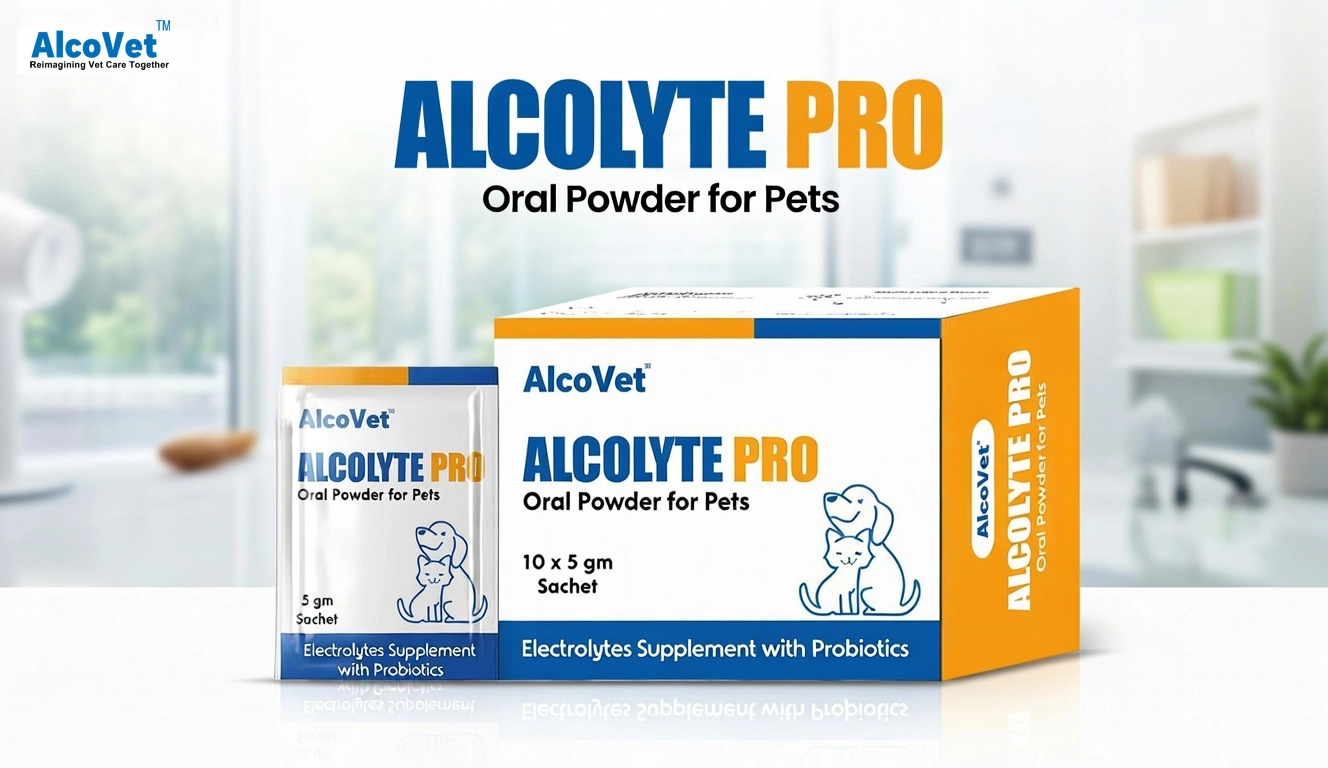
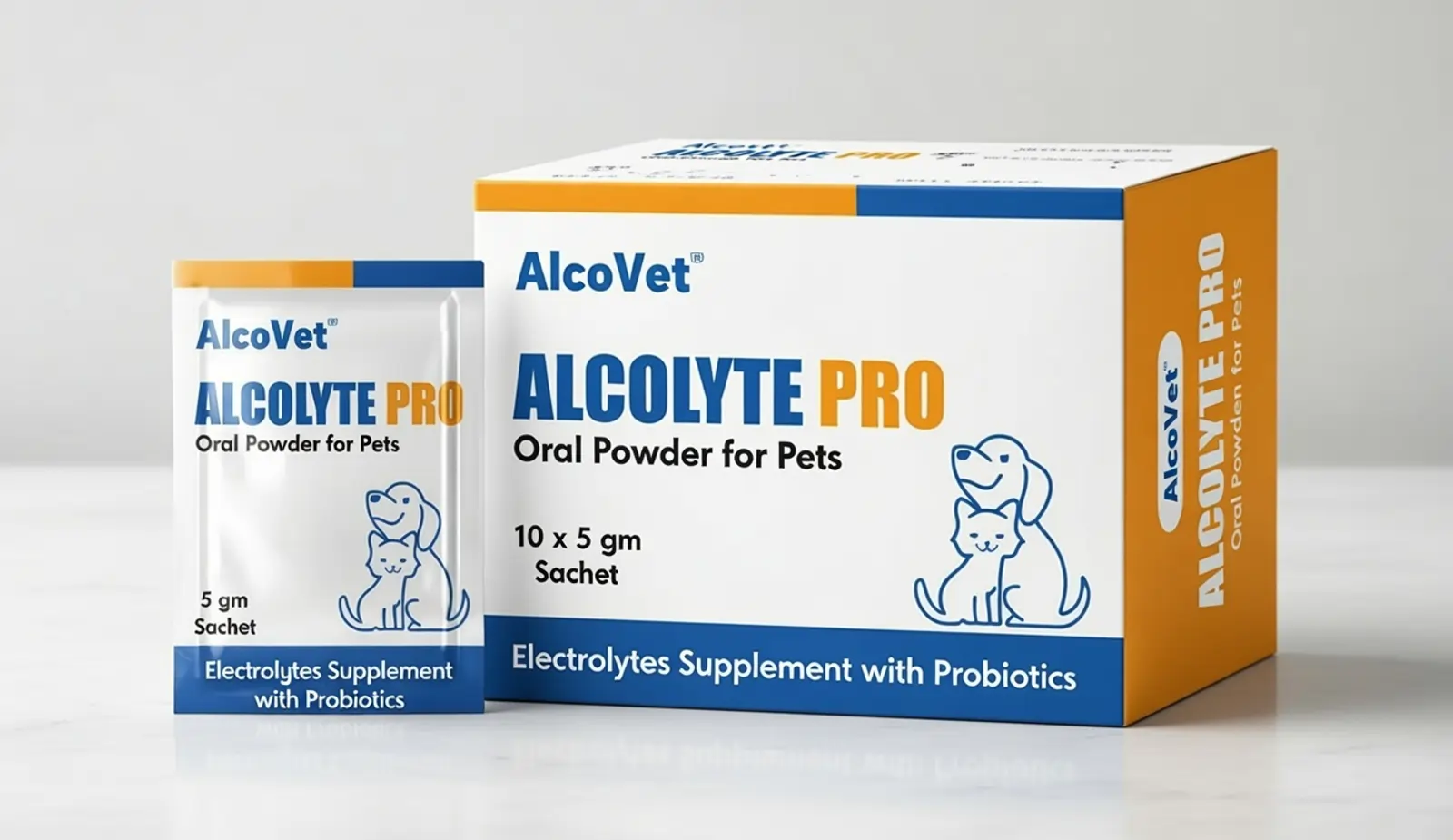
Alcolyte Pro
Electrolyte & Probiotic Oral Powder for Dogs & Cats
Overview & Clinical Rationale
Gastrointestinal disturbances — including acute diarrhoea, vomiting and dietary-induced GI upset — are among the most common presentations in companion animal practice. These conditions rapidly deplete electrolytes, compromise mucosal integrity and disrupt the intestinal microbiome, creating a cycle of poor absorption and delayed recovery.
Alcolyte Pro provides a dual-action oral support system: balanced electrolyte replenishment for effective rehydration via sodium-glucose cotransport, and multi-strain probiotic supplementation to restore gut microbial balance and intestinal homeostasis — together accelerating physiological recovery in dogs and cats, including the post-FPV discharge phase.
FPV (Feline Panleukopenia) Post-Discharge Recovery
Alcolyte Pro is specifically suited to the discharge and home recovery phase of FPV — once IV fluid therapy is complete and oral intake is tolerated. FPV causes severe hypokalaemia and profound microbiome disruption; Alcolyte Pro addresses both. View the FPV protocol on the GI Therapy Ladder.
Position in the AlcoVet GI Therapy Ladder
Alcolyte Pro represents Phase 2 — Restore in AlcoVet's GI Therapy Ladder. It follows digestive enzyme stabilisation (Phase 1 — Alcozyme) and prepares the gut for appetite restoration and nutritional rebuild (Phase 3 — OrexiGuard).
Stabilise
Alcozyme — digestive enzyme support
Restore
Alcolyte Pro — rehydration & microbiome
Rebuild
OrexiGuard — appetite recovery
GI Therapy Ladder — Phase 2 of 3
View the full Stabilise → Restore → Rebuild clinical framework including the FPV post-discharge protocol.
Key Ingredients & Mechanisms
Sodium
The primary extracellular cation, sodium drives the sodium-glucose cotransport (SGLT-1) mechanism in intestinal enterocytes — enabling active water absorption even during active secretory diarrhoea. Correcting hyponatraemia restores fluid distribution across compartments.
Potassium
Diarrhoea and vomiting cause rapid faecal and emetic potassium loss — hypokalaemia is one of the primary life-threatening complications of FPV specifically. Oral potassium replacement restores intracellular balance and supports normal GI motility during recovery.
Chloride
Chloride is the principal extracellular anion lost alongside sodium during secretory diarrhoea. Balanced chloride replacement maintains acid-base equilibrium and supports the osmotic gradient needed for efficient oral rehydration.
Glucose
Glucose is an essential co-substrate for SGLT-1 mediated sodium and water absorption in the small intestine. Even at low concentrations, glucose dramatically improves electrolyte uptake efficiency — the pharmacological basis of the WHO oral rehydration solution principle.
Multi-Strain Probiotics
GI illness and FPV cause severe intestinal microbiome disruption. Multi-strain probiotic supplementation restores microbial diversity, competes with pathobionts, supports mucosal barrier integrity and modulates intestinal immune responses during recovery.
Synergistic Dual Action
The combination of electrolytes and probiotics in a single formulation addresses both the acute fluid deficit (via electrolyte cotransport) and the underlying microbiome disruption (via probiotic colonisation) — comprehensive Phase 2 GI restoration in one sachet.
Indications
Alcolyte Pro is indicated for oral rehydration, electrolyte replenishment and gut microbiome support in the following clinical scenarios:
- Post-parvoviral (FPV) recovery — oral electrolyte and probiotic support during the discharge and home recovery phase, once IV fluid therapy is complete and oral intake is tolerated
- Acute diarrhoea — dietary-induced, stress-related or post-infectious, where oral rehydration is clinically appropriate
- Mild to moderate dehydration — from GI fluid losses
- Vomiting with fluid loss — supportive electrolyte replacement once vomiting has subsided and oral intake is tolerated
- Post-antibiotic microbiome disruption — probiotic restoration following broad-spectrum antibiotic courses
- Dietary transition support — reducing GI upset during food changes or novel protein introduction
- Travel, boarding or environmental stress — prophylactic and supportive gut stabilisation
- Paediatric and geriatric patients — supportive hydration in vulnerable populations with limited fluid reserves
OTC and Protocol Use
Alcolyte Pro may be used as short-term OTC support in mild, transient GI upset. For FPV recovery, moderate presentations or GI Ladder integration, veterinary direction is strongly recommended.
When ORS Alone Is Insufficient
Oral rehydration therapy is effective for mild to moderate fluid losses. The following presentations require immediate veterinary assessment and IV fluid therapy:
Seek Urgent Veterinary Care — Do Not Rely on ORS Alone
- Severe dehydration (>8% body weight loss) — requires IV fluid resuscitation
- Active FPV with persistent vomiting — requires inpatient IV therapy; ORS is for the post-discharge phase only
- Haemorrhagic diarrhoea or melaena — requires diagnostic evaluation and systemic therapy
- Suspected GI obstruction or intussusception — oral fluids contraindicated
- Systemic collapse, shock or altered mentation — emergency inpatient management required
- No clinical improvement after 24–48 hours of ORS — re-evaluate with veterinary examination
Usage & Administration
- Oral powder — dissolve in fresh drinking water as directed on product labelling before administration
- Dosage adjusted by species and body weight — refer to product monograph or labelling for full weight-based guidance
- In FPV recovery, administer in small, frequent volumes throughout the day — particularly in the first 24–48 hours post-discharge
- Compatible with concurrent digestive enzyme support (Alcozyme — Phase 1) as part of the GI Therapy Ladder
- Use freshly prepared solution for each administration — do not store reconstituted powder solution
- Suitable for both acute short-term use and ongoing probiotic maintenance in chronic GI sensitivity cases
- Store in a cool, dry place; keep sachet sealed until use
Full Monograph & Dosing
Full dosing by body weight, probiotic strain data and clinical monograph available on request — Download here
Composition & Pack Information
| Active Components | Sodium, Potassium, Chloride (electrolyte blend); Glucose (cotransport substrate); Multi-strain Probiotics |
|---|---|
| Formulation | Palatable oral powder — dissolve in water before use |
| Route | Oral — reconstituted solution; may be offered alongside food |
| Pack Size | 10 × 5 gm sachets per carton |
| Target Species | Dogs & Cats |
| Storage | Store in a cool, dry place below 25°C. Keep sachet sealed until use. Do not store reconstituted solution. |
| GI Ladder Position | Phase 2 — Restore |
| Key Indication | FPV post-discharge recovery; acute diarrhoea; mild–moderate dehydration; post-antibiotic microbiome restoration |
| Availability | OTC for mild acute use; veterinary protocol use recommended for FPV recovery and moderate presentations |
| Full Monograph | Dosing by body weight, full ingredient list and probiotic strain data available on request. Download here |
Frequently Asked Questions
What is Alcolyte Pro used for in dogs and cats?
Does Alcolyte Pro help in feline panleukopenia (FPV)?
What electrolytes does Alcolyte Pro contain?
Can Alcolyte Pro be used with Alcozyme and OrexiGuard?
Is Alcolyte Pro safe for cats and kittens?
Can Alcolyte Pro be used without veterinary consultation?
Selected References
References support the scientific basis of this formulation. All therapeutic decisions should be made by a qualified veterinarian.
- 1 Marks SL, Rankin SC, Byrne BA, Weese JS. Enteropathogenic bacteria in dogs and cats: diagnosis, epidemiology, treatment, and control. J Vet Intern Med. 2011;25(6):1195–1208. doi:10.1111/j.1939-1676.2011.00821.x
- 2 Schmitz S, Suchodolski J. Understanding the canine intestinal microbiota and its modification by pro-, pre- and synbiotics. Vet Med Sci. 2016;2(2):71–94. doi:10.1002/vms3.17
- 3 Truyen U, Addie D, Belák S, et al. Feline panleukopenia. ABCD guidelines on prevention and management. J Feline Med Surg. 2009;11(7):538–546. doi:10.1016/j.jfms.2009.05.002
- 4 Vaden SL, Knoll JS, Smith FWK, Tilley LP, eds. Blackwell's Five-Minute Veterinary Consult: Canine and Feline. 5th ed. Wiley-Blackwell; 2011. Oral rehydration therapy entry.
- 5 DiBartola SP. Fluid, Electrolyte, and Acid-Base Disorders in Small Animal Practice. 4th ed. St. Louis, MO: Elsevier Saunders; 2012. Comprehensive physiological basis for sodium-glucose cotransport mechanisms and oral electrolyte replacement in volume-depleted companion animals.
- 6 Wynn SG. Probiotics in veterinary practice. J Am Vet Med Assoc. 2009;234(5):606–613. Reviews the clinical efficacy of multi-strain probiotics in mitigating acute and chronic gastrointestinal disturbances.
- 7 Mohr AJ, Leisewitz AL, Jacobson LS, et al. Effect of early enteral nutrition on intestinal permeability, intestinal protein loss, and outcome in dogs with severe parvoviral enteritis. J Vet Intern Med. 2003;17(6):791-798. Provides strong clinical evidence that early oral/enteral support during and immediately following FPV accelerates enterocyte recovery and restores intestinal mucosal integrity.
Alcolyte Pro is Phase 2 — Restore in AlcoVet's GI Therapy Ladder. View the complete FPV protocol and the full Stabilise → Restore → Rebuild framework.