

Deworming — Internal Parasite Control
A foundational pillar of preventive veterinary care — structured, vet-led parasite management for dogs and cats across all life stages, integrating diagnostics, clinical protocols and owner education.
Why Deworming Matters Clinically
Internal parasites are among the most prevalent yet underdiagnosed conditions in companion animals in India. Dogs and cats in multi-pet households, those with outdoor access, or young animals are at heightened risk. The clinical impact extends well beyond overt GI signs.
Gut Health & Absorption
Intestinal parasites physically disrupt mucosal integrity, competing for nutrients and triggering chronic enteropathy — even at low burdens in young animals.
Growth & Development
Parasite burden in puppies and kittens directly impairs weight gain, coat quality and skeletal development — deworming is inseparable from nutrition in the growth phase.
Immune Modulation
Heavy parasite loads skew the immune response, reducing vaccine efficacy and increasing susceptibility to secondary infections in both young and immunocompromised animals.
Zoonotic Risk
Toxocara spp., Ancylostoma spp. and Giardia pose genuine public health risk, particularly in households with children, elderly or immunocompromised individuals.
Common Internal Parasites — Dogs & Cats
Roundworms (Toxocara spp.)
Most prevalent in puppies and kittens — transmitted via dam milk, transplacental route, ingestion of infected soil or paratenic hosts. Pot-bellied appearance, poor growth, vomiting.
ZoonoticHookworms (Ancylostoma spp.)
Haematophagous — cause significant blood-loss anaemia in young animals. Transmit via skin penetration, ingestion and transplacental. Pale mucous membranes, weakness, tarry stools.
Zoonotic — Cutaneous Larva MigransTapeworms (Dipylidium / Taenia spp.)
Transmitted via flea ingestion (Dipylidium caninum) or prey/raw meat (Taenia spp.). Proglottids visible in faeces or perianal region. Often asymptomatic but can cause perianal pruritus.
Flea-associatedWhipworms (Trichuris vulpis)
Dogs primarily — caecum and colon. Large-bowel diarrhoea, haematochezia, weight loss. Eggs resistant in environment for years. Requires anthelmintic with whipworm activity.
Dogs — Caecum/ColonGiardia (Giardia duodenalis)
Protozoan — not a helminth but managed alongside deworming protocols. Waterborne and faecal-oral transmission. Chronic soft/greasy stools, weight loss. Requires specific protozoal treatment.
ZoonoticLungworms (Angiostrongylus / Aelurostrongylus)
Emerging in India. Transmitted via snail/slug intermediate hosts. Cough, exercise intolerance, respiratory distress, haemorrhagic signs. Confirm via Baermann or BAL.
Requires specific coverDeworming Portfolio
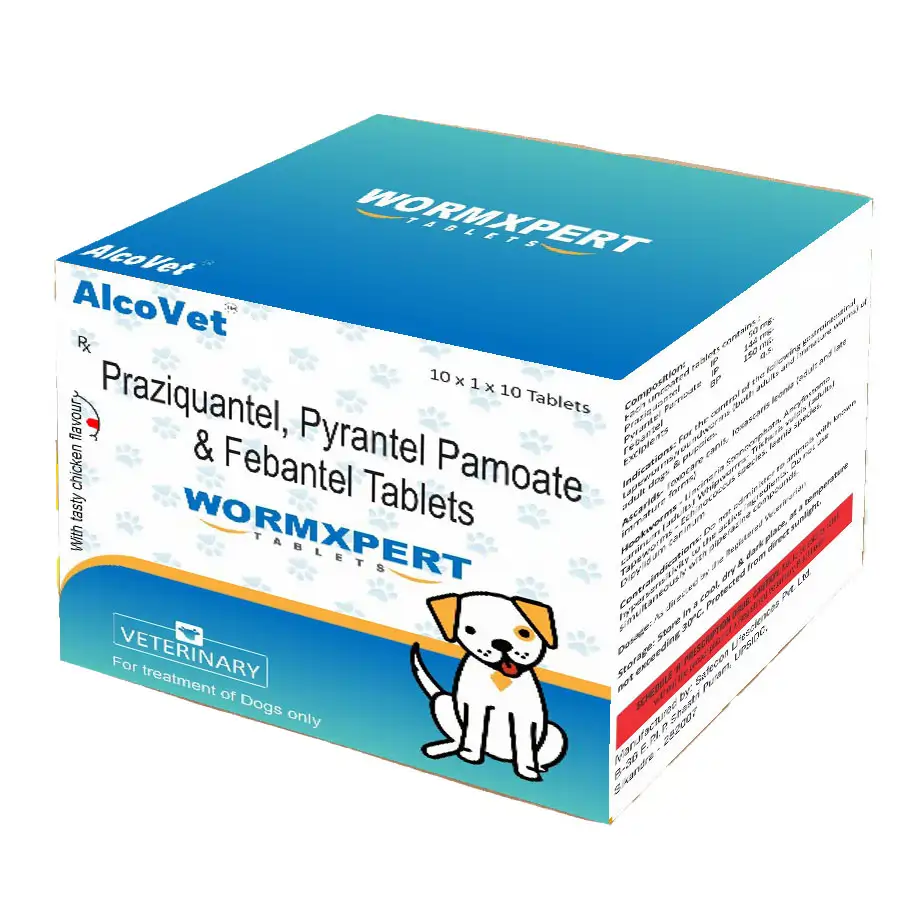
WormXpert
Broad-spectrum anthelmintic oral suspension covering the key intestinal nematodes and cestodes in dogs and cats — formulated for palatability and clinic-defined dosing schedules under veterinary supervision.
- Routine deworming — puppies and kittens from 2–3 weeks of age
- Adult dogs and cats on risk-stratified schedules (quarterly to 6-monthly)
- Pre- and post-adoption deworming protocols
- Integration with stool examination, flea control and hygiene counselling
- Multi-pet household management protocols
- Dose strictly by body weight. Confirm coverage spectrum with product monograph before use.
Deworming Schedule — Life-Stage Framework
The following is a general framework — actual frequency must be personalised by the veterinarian based on faecal examination findings, lifestyle factors, geographic risk and concurrent parasite control.
| Life Stage | Starting Age / Timing | Suggested Frequency | Key Considerations |
|---|---|---|---|
| Puppies / Kittens | 2–3 weeks of age | Every 2 weeks until 12 weeks | High Toxocara burden; treat dam concurrently; confirm product age-safety |
| 3–6 months | After initial puppy/kitten course | Monthly | High environmental exposure; growing immune system; stool check recommended |
| 6 months – 1 year | Continuing preventive | Every 1–3 months | Based on lifestyle — outdoor access, raw diet, multi-pet household |
| Adult Dogs & Cats | Maintenance protocol | Quarterly (high risk) / 6-monthly (low risk) | Faecal float guides frequency; flea control concurrent for tapeworm prevention |
| Pregnant / Lactating Dam | Late gestation + at whelping | Vet-directed | Reduces transplacental and milk-borne Toxocara transmission to pups |
| Rescue / Shelter Animals | On intake | Immediate + 2-week repeat | Unknown history — treat empirically; faecal examination to guide follow-up |
Clinic Protocol Framework
Diagnostics — Before You Deworm
Faecal Examination
- Faecal float (zinc sulphate / sugar) — nematode and cestode eggs
- Faecal smear — Giardia trophozoites (fresh sample within 30 min)
- Giardia SNAP / ELISA antigen test — higher sensitivity than smear
- Baermann technique — if lungworm suspected (L1 larvae)
Integrated Control Principles
- Simultaneous flea control — eliminates tapeworm intermediate host
- Environmental hygiene counselling — prompt faecal disposal
- Raw/undercooked meat avoidance — reduces Taenia / Toxoplasma risk
- Water source hygiene — Giardia prevention in multi-dog households
Resistance & Special Considerations
Anthelmintic Resistance Risk
- Avoid routine under-dosing — weight-based dosing is mandatory
- Rotate drug classes only when faecal egg count reduction confirms resistance
- Do not deworm prophylactically at flat doses in multi-dog kennels — risk of resistance amplification
MDR1 / ABCB1 Mutation (Collies & Relatives)
- Rough / Smooth Collie, Shetland Sheepdog, Australian Shepherd — confirm MDR1 status before using macrocyclic lactones
- Ivermectin and milbemycin can cause neurotoxicity in affected dogs at standard doses
High-Risk Groups & Life Stages
Why AlcoVet Deworming
Broad-Spectrum Cover
WormXpert targets the key intestinal nematodes and cestodes affecting dogs and cats in India — reducing the need for multiple products in a standard preventive protocol.
Clinic-Controlled Protocol
Designed for veterinary prescription and follow-up — not an OTC product. Positions your clinic as the authority on parasite prevention and client compliance.
Dogs & Cats — Both Species
Species-adjusted dosing for dogs and cats in one formulation — practical for mixed companion animal clinics with high throughput.
All Life Stages
Protocol-ready from early puppyhood through adult maintenance — supports the full preventive care journey from first vaccination visit onwards.
GMP Manufactured
Consistent potency and purity through ISO 9001:2015 quality management and GMP-certified manufacturing partners — batch-to-batch reliability.
Stockist & Clinic Support
Protocol guides, client education materials and stockist onboarding support available — contact AlcoVet to integrate WormXpert into your preventive care programme.
Build WormXpert into your preventive care programme.
Request product monographs, protocol guides, clinic samples or stockist terms.