
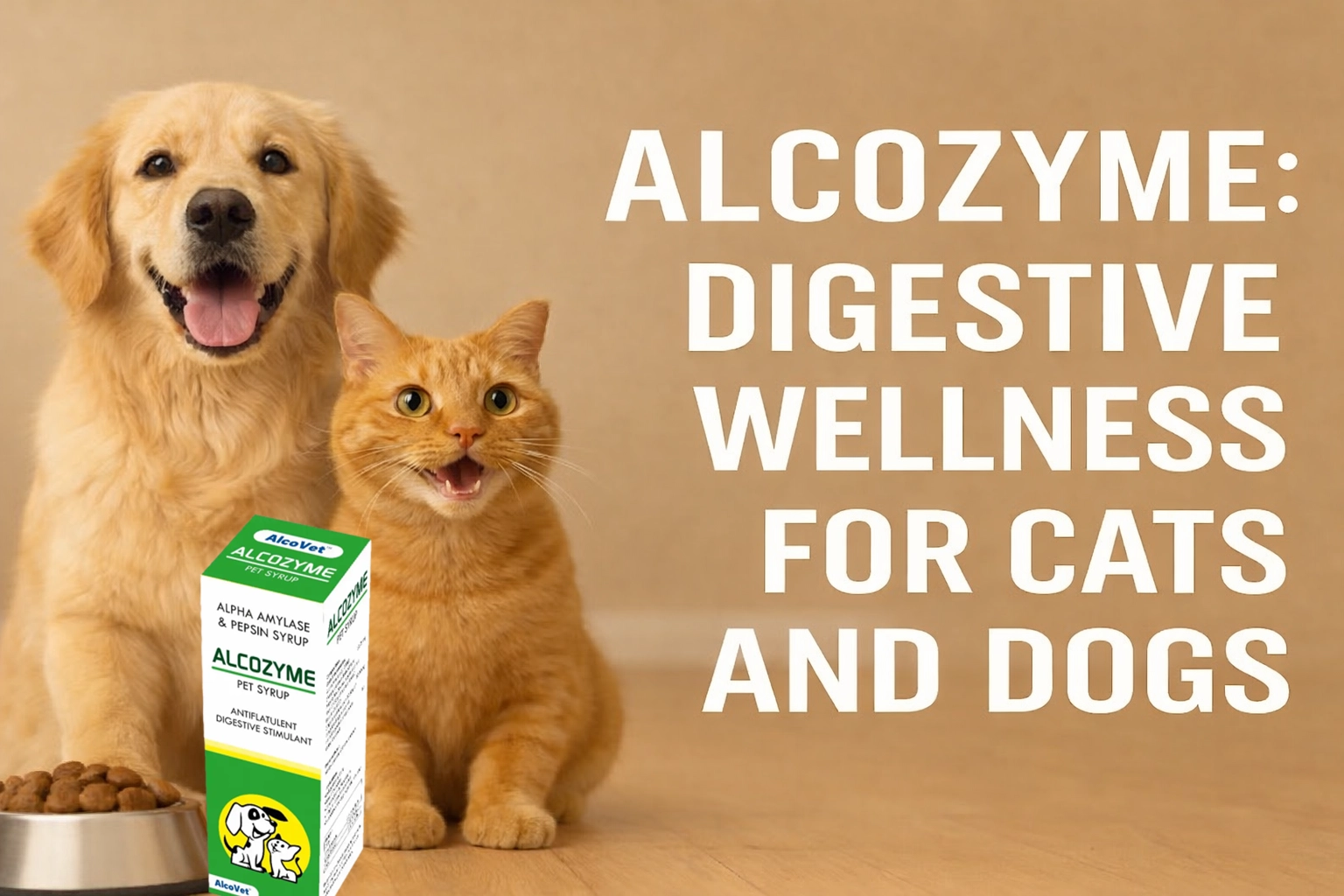
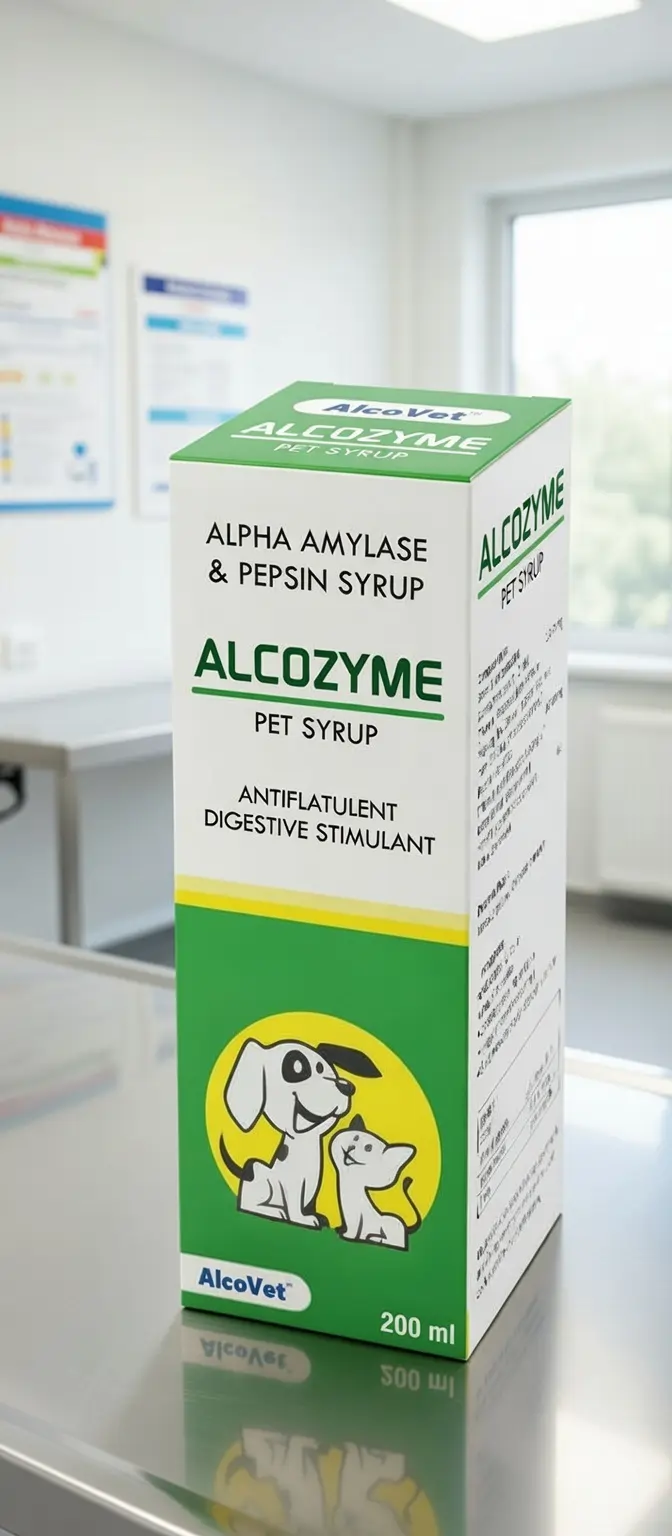
Alcozyme
Digestive Enzyme Syrup for Dogs & Cats
Overview & Clinical Rationale
Adequate enzymatic activity is fundamental to gastrointestinal health in companion animals. When endogenous enzyme production is insufficient — due to dietary transitions, stress, illness, post-surgical recovery or age-related decline — macronutrient breakdown becomes incomplete, leading to malabsorption, nutrient loss, loose stools and poor body condition.
Alcozyme provides targeted exogenous enzyme support through Alpha Amylase and Pepsin — addressing both carbohydrate and protein digestion to reduce GI load and improve nutrient bioavailability during recovery and maintenance phases.
Position in the AlcoVet GI Therapy Ladder
Alcozyme represents Phase 1 — Stabilise in AlcoVet's GI Therapy Ladder. It is the foundation step, reducing digestive stress and supporting macronutrient processing before rehydration (Phase 2 — Alcolyte Pro) and appetite recovery (Phase 3 — OrexiGuard) are introduced.
Stabilise
Alcozyme — digestive enzyme support
Restore
Alcolyte Pro — rehydration & microbiome
Rebuild
OrexiGuard — appetite recovery
GI Therapy Ladder — Phase 1 of 3
View the full stepwise Stabilise → Restore → Rebuild clinical framework for comprehensive gastrointestinal care.
Key Ingredients & Mechanisms
Alpha Amylase
A carbohydrate-digesting enzyme that catalyses the hydrolysis of starch and glycogen into maltose and simpler sugars. Supports efficient carbohydrate digestion when salivary and pancreatic amylase output is reduced — common during illness, dietary transition and post-surgical recovery.
Pepsin (Acid Protease)
A gastric protease that facilitates the breakdown of dietary proteins into peptides and amino acids in the acidic environment of the stomach. Supports protein digestion in patients with reduced gastric secretory activity, including senior animals and those recovering from GI illness.
Complementary Dual Action
Alpha Amylase and Pepsin together address the two primary macronutrient digestion pathways — carbohydrate and protein — in a single oral formulation. This dual-enzyme approach reduces digestive load broadly and improves overall nutrient assimilation efficiency.
Why Exogenous Enzymes Help
In companion animals, endogenous enzyme secretion can be compromised by stress, illness, ageing or dietary changes. Supplementing with bioavailable Alpha Amylase and Pepsin bridges this gap — ensuring continued macronutrient processing even when the gut's own secretory capacity is temporarily or chronically reduced.
Indications
Alcozyme is indicated as digestive enzyme support in the following clinical scenarios:
- Acute indigestion — impaired macronutrient digestion, nutrient malabsorption and post-prandial GI discomfort
- Dietary transition support — during food changes or introduction of new ingredients
- Post-illness GI recovery — following gastroenteritis, parvoviral enteritis or systemic illness
- Post-antibiotic digestive disruption — restoring enzymatic activity following broad-spectrum antibiotic courses
- Senior patients — age-related decline in pancreatic and gastric enzyme secretion
- Chronic GI sensitivity — adjunct support in patients with recurrent digestive upset under veterinary management
- Post-surgical GI stasis — enzyme supplementation to aid early enteral nutrition recovery
Clinical Note
Digestive enzyme supplementation provides symptomatic and supportive benefit. Persistent, recurrent or severe GI signs require full diagnostic evaluation. Alcozyme does not replace disease-specific veterinary treatment.
Usage & Administration
- Oral syrup — administer directly or mix into food
- Dosage adjusted by species, body weight and clinical presentation — refer to product labelling
- Compatible with concurrent probiotic and electrolyte therapy (Alcolyte Pro — GI Ladder Phase 2)
- Suitable for short-term acute support and longer-term adjunct use in chronic conditions under veterinary guidance
- Palatable formulation — suitable for both dogs and cats
- Store below 25°C, away from direct sunlight
Regulatory & OTC Status
Alcozyme may be used as short-term over-the-counter support in mild, transient digestive upset. For persistent signs, post-illness recovery or integration into a structured GI management plan, use under veterinary direction is strongly recommended. Full weight-based dosing is provided in the product monograph — Download here .
Composition & Pack Information
| Active Ingredients | Alpha Amylase, Pepsin |
|---|---|
| Formulation | Palatable oral syrup |
| Route | Oral — direct or mixed with food |
| Pack Size | 200 ml bottle |
| Target Species | Dogs & Cats |
| Storage | Store below 25°C; protect from direct sunlight |
| GI Ladder Position | Phase 1 — Stabilise |
| Availability | Veterinary channel — OTC for mild acute use; prescription recommended for protocol-based use |
| Full Monograph | Dosing by body weight, full excipient list and stability data available on request. Download here |
Frequently Asked Questions
What is Alcozyme used for in dogs and cats?
What enzymes does Alcozyme contain?
Can Alcozyme be used alongside probiotics or electrolytes?
Is Alcozyme suitable for long-term use?
Is Alcozyme safe for cats as well as dogs?
Selected References
References support the scientific basis of this formulation. They do not constitute clinical recommendations. All therapeutic decisions should be made by a qualified veterinarian.
- 1 Steiner JM. Exocrine pancreatic insufficiency in dogs and cats. Vet Clin North Am Small Anim Pract. 2012;42(2):355–367. doi:10.1016/j.cvsm.2012.01.006 PMID: 22381180
- 2 Simpson KW, Jergens AE. Pitfalls and progress in the diagnosis and management of canine inflammatory bowel disease. Vet Clin North Am Small Anim Pract. 2011;41(2):381–398. doi:10.1016/j.cvsm.2011.01.001 PMID: 21486646
- 3 German AJ, Hall EJ, Day MJ. Chronic intestinal inflammation and intestinal disease in dogs. J Vet Intern Med. 2003;17(1):8–20. doi:10.1111/j.1939-1676.2003.tb01318.x PMID: 12564715
- 4 Schmitz S, Suchodolski J. Understanding the canine intestinal microbiota and its modification by pro-, pre- and synbiotics. Vet Med Sci. 2016;2(2):71–94. doi:10.1002/vms3.17 PMID: 29067189
- 5 Washabau RJ, Day MJ. Canine and Feline Gastroenterology. St. Louis, MO: Elsevier Saunders; 2013. Foundational veterinary textbook detailing normal gastric and pancreatic digestive physiology, and the therapeutic rationale for exogenous enzyme supplementation.
- 6 Xenoulis PG, Steiner JM. Canine exocrine pancreatic insufficiency. Compend Contin Educ Vet. 2008;30(12):E1-14. Clinical review supporting the use of oral digestive enzymes to stabilize macronutrient assimilation in states of compromised endogenous enzyme production.
Alcozyme is Phase 1 — Stabilise in AlcoVet's GI Therapy Ladder. Continue to Phase 2 (Alcolyte Pro) for rehydration and microbiome restoration.