
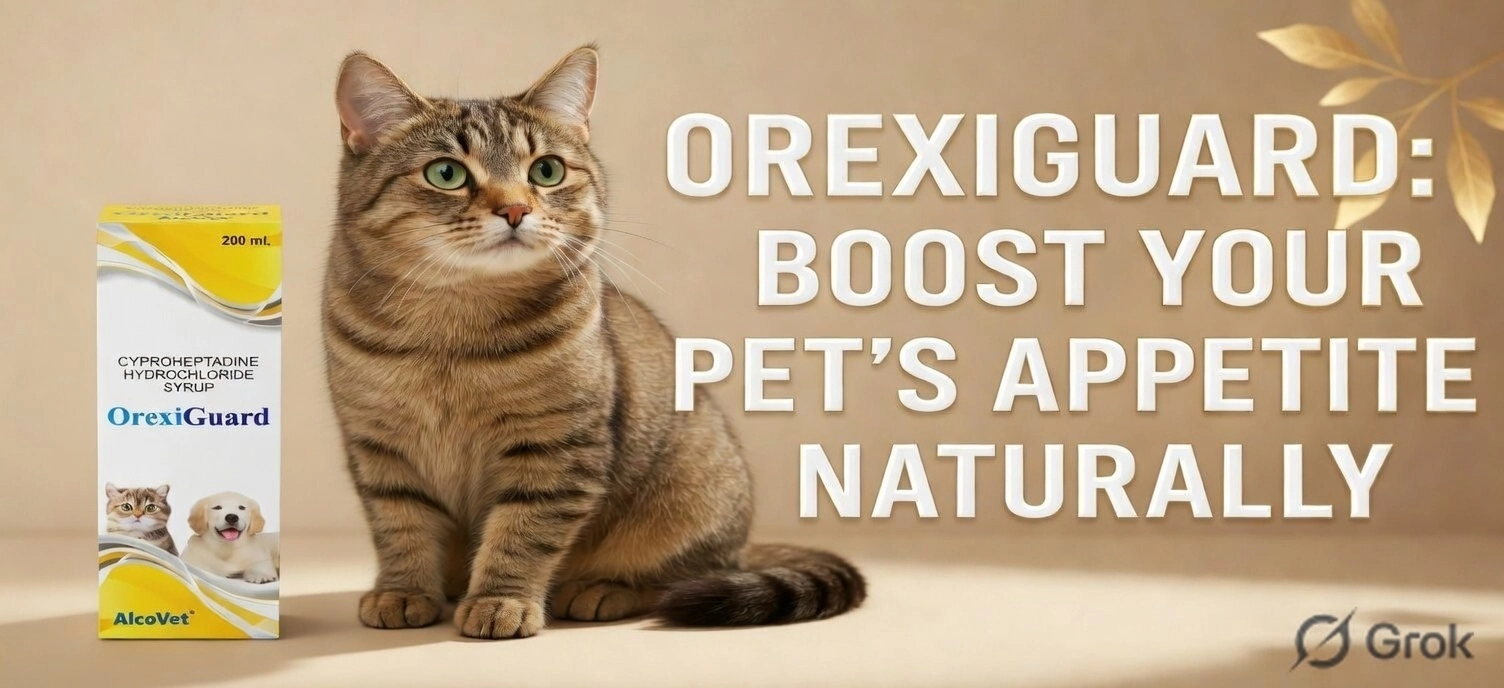
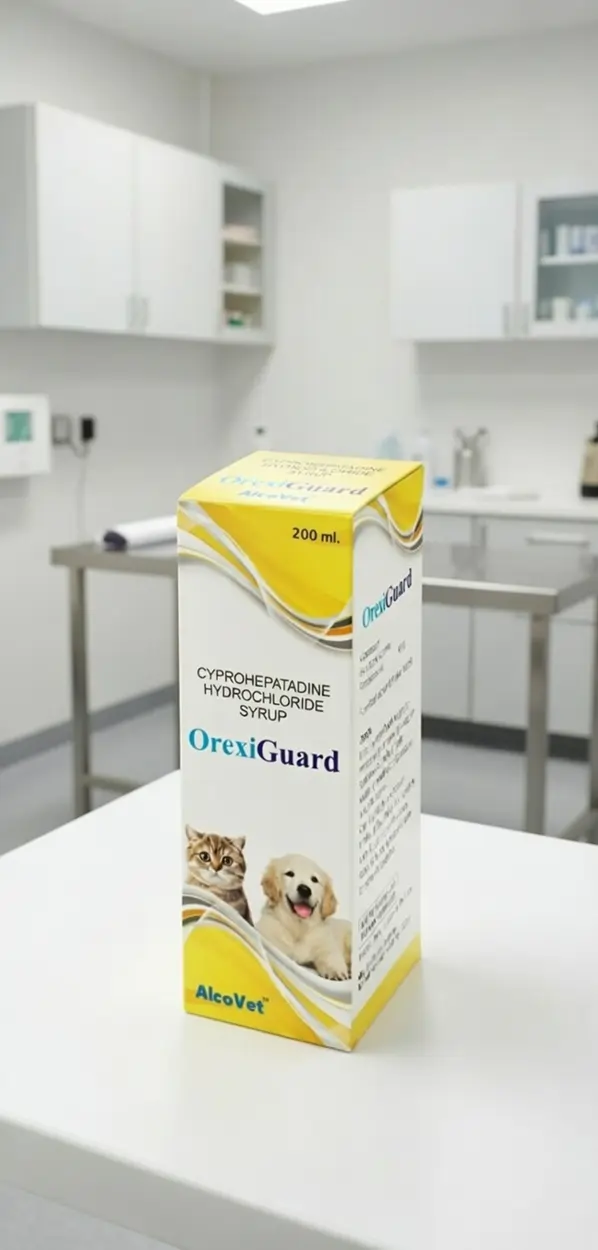
OrexiGuard
Appetite Stimulant Syrup for Dogs & Cats
Overview & Clinical Rationale
Voluntary food intake is the cornerstone of nutritional recovery in companion animals. Following illness, surgery, hospitalisation or prolonged GI disturbance, many patients remain inappetent even after clinical stabilisation — creating a critical window where caloric deficit compounds recovery time and delays return to normal body condition.
OrexiGuard provides targeted appetite stimulation through Cyproheptadine — a serotonin antagonist and antihistamine that reduces serotonin-mediated suppression of feeding behaviour. This supports the resumption of voluntary eating in hyporexic or anorexic patients, enabling nutritional rehabilitation to begin.
Position in the AlcoVet GI Therapy Ladder
OrexiGuard represents Phase 3 — Rebuild in AlcoVet's GI Therapy Ladder. It should be introduced once vomiting, diarrhoea and dehydration have been corrected (Phases 1 and 2) but adequate voluntary feeding has not resumed.
Stabilise
Alcozyme — digestive enzyme support
Restore
Alcolyte Pro — rehydration & microbiome
Rebuild
OrexiGuard — appetite & nutrition recovery
GI Therapy Ladder — Phase 3 of 3
View the full stepwise Stabilise → Restore → Rebuild clinical framework for comprehensive gastrointestinal care.
Mechanism of Action
Serotonin (5-HT) Antagonism
Cyproheptadine competitively blocks serotonin receptors — particularly 5-HT2 receptors in the hypothalamus. Serotonin normally suppresses appetite; blocking these receptors reduces this inhibitory signal, increasing the drive to eat in anorexic patients.
H1 Antihistamine Activity
As a first-generation antihistamine, cyproheptadine also blocks histamine H1 receptors — contributing to mild sedation and reduced nausea perception, which may further support feeding behaviour in nauseated or stressed patients.
Orexigenic Effect
The combined serotonin and histamine antagonism results in a measurable increase in voluntary food intake. This effect is well-documented in cats and has been reported in dogs — making cyproheptadine one of the most widely used pharmacological appetite stimulants in small animal veterinary practice.
Onset & Duration
Appetite-stimulating effects are typically observed within 1–2 hours of administration in responsive patients. Duration of effect is approximately 4–8 hours per dose, supporting meal-time administration protocols as directed by the attending veterinarian.
Indications
OrexiGuard is indicated for appetite stimulation and nutritional recovery support in the following clinical presentations:
- Post-gastroenteritis anorexia — when GI stability has been achieved but voluntary feeding has not resumed
- Post-parvovirus recovery — nutritional rehabilitation following inpatient management
- Post-surgical inappetence — supporting early voluntary feeding after GI or other major surgery
- Chronic systemic illness — appetite support in patients with cancer, renal disease or other chronic conditions
- Stress-related anorexia — boarding, hospitalisation or environmental change-induced appetite suppression
- Cachexia and weight loss — nutritional rehabilitation in patients with poor body condition score
- Feline hepatic lipidosis risk — early appetite intervention to prevent anorexia-induced fat mobilisation in cats
Clinical Note
OrexiGuard stimulates appetite but does not treat the underlying cause of inappetence. Full diagnostic evaluation is essential in all cases of persistent or recurrent anorexia. Appetite stimulation should always be part of a broader nutritional and clinical management plan.
Contraindications & Precautions
As a prescription compound, cyproheptadine carries specific contraindications and precautions that must be reviewed before initiation:
Contraindications — Do Not Use In
- Glaucoma — anticholinergic properties may increase intraocular pressure
- Urinary retention — anticholinergic activity may worsen urinary outflow obstruction
- Significant cardiac disease — use with caution; cardiovascular monitoring recommended
- Hypersensitivity to cyproheptadine or any component of the formulation
- Concurrent MAOI therapy — risk of serotonin-related interactions
Monitor During Use
Monitor for sedation (particularly in cats), anticholinergic effects (dry mouth, reduced GI motility) and paradoxical excitability. Taper gradually when discontinuing after prolonged use. All monitoring decisions to be made by the attending veterinarian.
Usage & Administration
- Oral syrup — administer directly or mix with a small amount of palatable food
- Dosage is determined by the veterinarian based on species, body weight and clinical presentation
- Administer approximately 30–60 minutes before the intended meal time to maximise orexigenic effect
- Compatible with Alcozyme (Phase 1) and Alcolyte Pro (Phase 2) under veterinary guidance
- Taper when voluntary food intake is consistently adequate for ≥ 3 consecutive days
- Store below 25°C, away from direct sunlight
- Prescription only — to be used strictly under veterinary supervision
Prescription Requirement
OrexiGuard is a prescription-only veterinary product. Dosing by body weight, full safety data and clinical monograph are available to registered veterinary practitioners on request. Download here
Composition & Pack Information
| Active Ingredient | Cyproheptadine Hydrochloride |
|---|---|
| Pharmacological Class | Serotonin antagonist / H₁ antihistamine / Orexigenic agent |
| Formulation | Palatable oral syrup |
| Route | Oral — direct or mixed with food |
| Pack Size | 200 ml bottle |
| Target Species | Dogs & Cats |
| Storage | Store below 25°C; protect from direct sunlight |
| GI Ladder Position | Phase 3 — Rebuild |
| Regulatory Status | Prescription only — to be sold on the prescription of a Registered Veterinary Practitioner |
| Full Monograph | Dosing by body weight, full safety profile and excipient list available on request. Download here |
Frequently Asked Questions
What is OrexiGuard used for in dogs and cats?
How does cyproheptadine stimulate appetite?
When should OrexiGuard be introduced in the GI Ladder?
Can OrexiGuard be used with Alcozyme and Alcolyte Pro?
Is OrexiGuard safe for cats?
Is OrexiGuard safe for long-term use?
Selected References
References support the scientific and clinical basis of this formulation. They do not constitute prescribing recommendations. All therapeutic decisions should be made by a qualified veterinarian.
- 1 Papich MG. Saunders Handbook of Veterinary Drugs: Small and Large Animal. 4th ed. St. Louis: Elsevier; 2016. Cyproheptadine entry, pp. 201–203.
- 2 Quimby JM, Lunn KF. Mirtazapine as an appetite stimulant and anti-emetic in cats with chronic kidney disease. Vet J. 2013;197(3):651–655. doi:10.1016/j.tvjl.2013.05.048
- 3 Delaney SJ, Fascetti AJ, Elliott DA. Critical care nutrition of dogs. Clin Tech Small Anim Pract. 2006;21(3):121–127. doi:10.1053/j.ctsap.2006.05.005
- 4 Chan DL. The inappetent hospitalised cat: clinical approach to maximising nutritional support. J Feline Med Surg. 2009;11(11):925–933. doi:10.1016/j.jfms.2009.09.013
- 5 Chan DL, Freeman LM. Nutrition in Critical Illness. Vet Clin North Am Small Anim Pract. 2006;36(6):1225-1241. Detailed review demonstrating that early enteral feeding is crucial for maintaining GI mucosal integrity, preventing bacterial translocation, and accelerating recovery in critically ill or anorexic patients.
- 6 Macy DW, Ralston SL. Cause and control of decreased appetite. In: Kirk RW, ed. Current Veterinary Therapy X: Small Animal Practice. Philadelphia: WB Saunders; 1989. Foundational text validating the use of cyproheptadine as an effective pharmacological intervention to stimulate appetite, particularly in feline patients resistant to dietary modifications.
OrexiGuard is Phase 3 — Rebuild in AlcoVet's GI Therapy Ladder. For the complete Stabilise → Restore → Rebuild protocol, view the full Gastro Care portfolio.