
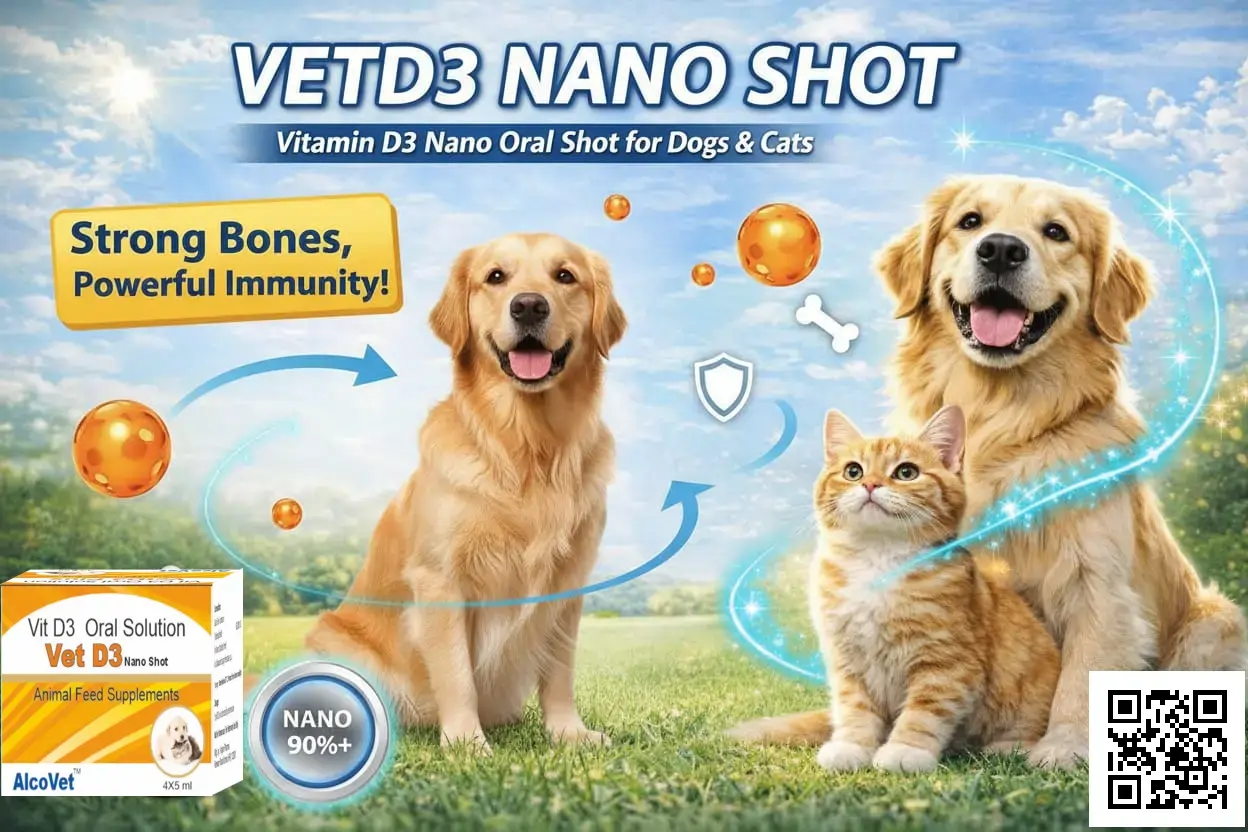
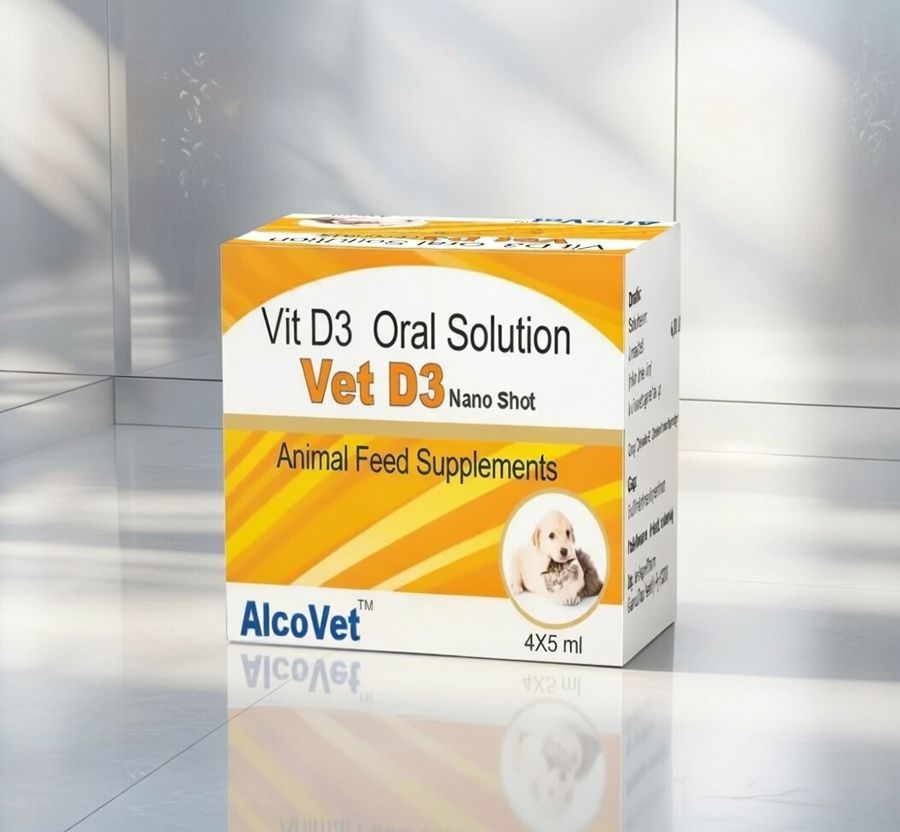
VetD3 Nano Shots
Highly Concentrated Nano-Emulsified Vitamin D3 Supplement
Overview & Physiological Role
Vitamin D plays a central endocrine role in maintaining calcium and phosphorus balance in dogs and cats. Unlike humans, companion animals rely almost entirely on dietary sources of vitamin D — cutaneous synthesis from UV exposure is negligible in most breeds, making dietary and supplemental sources clinically essential for skeletal health throughout all life stages.
Active vitamin D (calcitriol) binds nuclear receptors in the intestine, kidney and bone to regulate the absorption and renal reabsorption of calcium and phosphorus. Deficiency leads to rickets in growing animals and osteomalacia in adults — characterised by poor bone mineralisation, pathological fractures, and neuromuscular dysfunction.
Key Physiological Functions
- Regulates intestinal absorption of calcium and phosphorus
- Supports mineralisation of growing and remodelling bone
- Contributes to neuromuscular transmission and skeletal muscle function
- Regulates parathyroid hormone (PTH) secretion and calcium homeostasis
- Modulates innate immune function and inflammatory signalling pathways
Why Dietary D3 Is Critical in Companion Animals
Dogs and cats cannot synthesise meaningful quantities of vitamin D through sun exposure alone — unlike humans. Their skin lacks sufficient 7-dehydrocholesterol concentrations and the UV conversion pathway is functionally limited. This makes them uniquely dependent on dietary intake and supplementation when clinically required.
The Nano-Emulsification Advantage
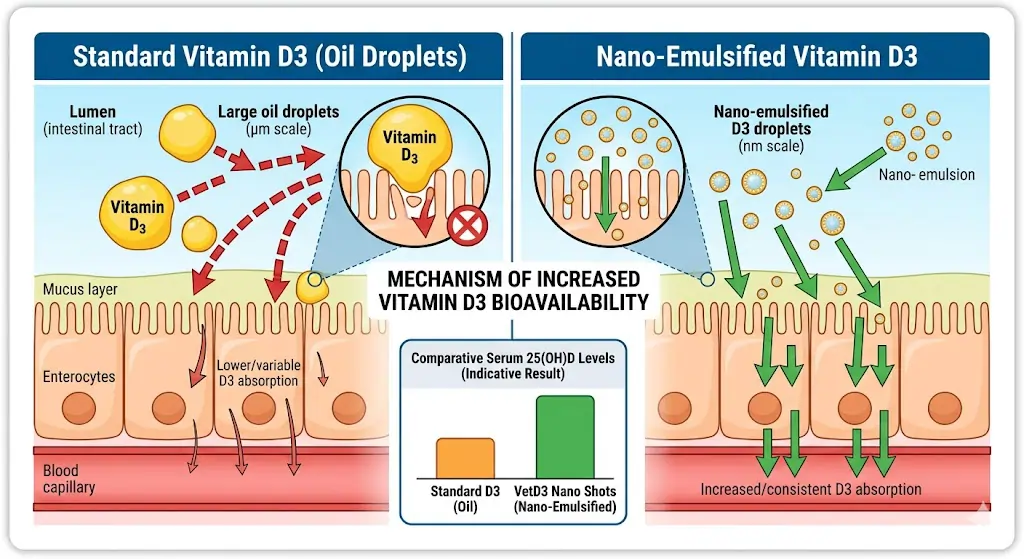
Vitamin D3 (cholecalciferol) is a fat-soluble vitamin with inherently variable oral absorption — dependent on bile acid secretion, pancreatic lipase activity, and intestinal fat handling. In conventional oil-based drops, particle size limits GI dispersion and absorption consistency.
Nano-Emulsification
Creates ultra-small lipid droplets (typically 20–200 nm) that disperse spontaneously in aqueous GI fluid, dramatically increasing surface area available for absorption across the intestinal epithelium.
Superior Bioavailability
Studies on nanoemulsion cholecalciferol demonstrate significantly higher 25(OH)D serum levels versus conventional soft gelatin capsule or oil-drop preparations — more consistent uptake, less inter-individual variability.
GI-Compromise Patients
Particularly valuable in animals with fat malabsorption, protein-losing enteropathy, exocrine pancreatic insufficiency, or post-surgical GI compromise — where conventional D3 absorption is unreliable and deficiency risk is elevated.
Cholecalciferol (D3)
The natural, animal-derived form of vitamin D. Absorbed and hydroxylated to 25(OH)D in the liver, then activated to 1,25(OH)₂D (calcitriol) in the kidney — the biologically active form that regulates calcium and phosphorus balance.
One Drop. Consistent Uptake.
The nano-emulsion format of VetD3 Nano Shots removes the unpredictability of conventional fat-soluble D3 — delivering more reproducible therapeutic serum levels with each dose, supporting safer dose titration and monitoring under veterinary supervision.
Primary Indications
VetD3 Nano Shots is indicated as nutritional support under veterinary direction in the following clinical scenarios:
- Growth phases — puppies and kittens with increased skeletal demand and rapid bone development requiring reliable D3 availability
- Orthopaedic recovery — post-fracture repair, bone remodelling and post-surgical mineralisation support where calcium–phosphorus balance is clinically relevant
- Dietary vitamin D insufficiency — documented or clinically suspected deficiency confirmed by serum 25(OH)D testing
- Indoor-only pets — minimal UV exposure with complete reliance on dietary D3 sources
- Large and giant breeds — elevated skeletal load during growth and increased D3 requirement in senior life stages with musculoskeletal decline
- GI malabsorption patients — protein-losing enteropathy, exocrine pancreatic insufficiency, IBD — where conventional D3 absorption is unreliable
- Adjunct nutritional support — where calcium–phosphorus homeostasis is part of the broader clinical treatment plan
Dosing & Administration
All dosing must be determined by the prescribing veterinarian based on baseline serum 25(OH)D, clinical status, body weight, and the degree of deficiency. The following are indicative ranges only — full species- and weight-based dosing charts are available in the product monograph on request.
| Patient Weight | ONCE WEEKLY Dose | Estimated Weekly IU |
|---|---|---|
| Small Dogs / Cats (<10 kg) | 0.25 mL — 0.5 mL / week | 3,000 IU — 6,000 IU |
| Medium Dogs (10–20 kg) | 0.5 mL — 1.0 mL / week | 6,000 IU — 12,000 IU |
| Large Dogs (20–40 kg) | 1.0 mL — 2.0 mL / week | 12,000 IU — 24,000 IU |
| Giant Breeds (>40 kg) | 2.0 mL — 3.0 mL / week | 24,000 IU — 36,000 IU |
Dispensing & Syringe Safety
Because doses are fractionated (e.g., 0.25 mL) due to the high concentration, VetD3 Nano Shots must be drawn and administered using a 1 mL graded oral syringe. Never dose this product freehand or using standard teaspoon measurements.
- Administer orally — can be given directly or mixed into food
- Shake gently before use if separation is visible in nano-emulsion
- Store below 25°C, away from direct light and heat; do not freeze
- Full weight-based dosing tables available on request — contact us
Never Exceed Prescribed Dose
Vitamin D3 has a narrow therapeutic margin. Do not increase dose without veterinary review and follow-up blood monitoring. Toxicity from excess D3 can cause irreversible soft-tissue mineralisation, renal failure and cardiac calcification.
Safety & Monitoring
Recommended Monitoring Parameters
Signs of Hypercalcaemia — Stop & Call Vet
Polyuria / polydipsia • Lethargy and weakness • Vomiting and inappetence • Muscle tremors • Constipation • Bradycardia. If any of these appear during supplementation, discontinue immediately and seek veterinary assessment with urgent calcium and renal bloods.
Composition & Pack Information
| Active Ingredient | Nano-emulsified Vitamin D3 (Cholecalciferol) — potency as per label |
|---|---|
| Formulation | High-bioavailability oral nano-emulsion solution |
| Route | Oral — administered directly or mixed into food |
| Target Species | Dogs & Cats |
| Pack Format | Multi-dose bottle — clinic dispensing format |
| Storage | Store below 25°C; protect from direct light and heat; do not freeze |
| Availability | Veterinary channel only — prescription required |
| Category | Veterinary Nutritional Supplement — Animal Feed Supplement |
| Full Monograph | Weight-based dosing charts, full excipient list and stability data available on request. Download here |
Frequently Asked Questions
Why is nano-emulsified D3 better than standard D3 drops?
Can VetD3 Nano Shots be given without a prescription?
Which patients benefit most from VetD3 Nano Shots?
What monitoring is required during supplementation?
Can VetD3 Nano Shots be used in cats?
Can it be mixed into food?
Selected References
References support the scientific basis of this formulation. They do not constitute clinical recommendations. All dosing and therapeutic decisions should be guided by a qualified veterinarian based on individual patient assessment.
- 1How KL, Hazewinkel HAW, Mol JA. Dietary vitamin D dependence of cat and dog due to inadequate cutaneous synthesis of vitamin D. Gen Comp Endocrinol. 1994;96(1):12–18. doi:10.1006/gcen.1994.1154
- 2Corbee RJ. Vitamin D in health and disease in dogs and cats. Adv Small Anim Care. 2020;1(1):265–277. Utrecht Research Portal
- 3Zafalon RVA, et al. The role of vitamin D in small animal bone metabolism. Metabolites. 2020;10(12):496. doi:10.3390/metabo10120496 PMID: 33287408
- 4Mellanby RJ, et al. Hypocalcaemia associated with low serum vitamin D metabolite concentrations in two dogs with protein-losing enteropathies. J Small Anim Pract. 2005;46(7):345–351. doi:10.1111/j.1748-5827.2005.tb00331.x
- 5Weidner N, et al. Vitamin D metabolism and disorders in dogs and cats. J Small Anim Pract. 2022;63(3):173–188. doi:10.1111/jsap.13401 PMID: 34323302
- 6Maurya VK, Bashir K, Aggarwal M. Vitamin D microencapsulation and fortification: trends and technologies. J Steroid Biochem Mol Biol. 2020;196:105510. doi:10.1016/j.jsbmb.2019.105510
- 7Sharma R, Bharti S, Kumar KH. Nanoemulsion oral solution of cholecalciferol vs soft gelatin capsules: an open-label, randomised, crossover bioavailability study. Nutrients. 2022;14(22):4800. doi:10.3390/nu14224800 PMID: 36407493 Cited for nanoemulsion bioavailability mechanism — human study; species extrapolation applies.
- 8Deshpande RP, Bhosale P, Bhadekar R. Bioavailability of nanoemulsion formulations vs conventional fat-soluble preparations of vitamin D. J Clin Diagn Res. 2019;13(10):OE01–OE04. PMC6834990 Cited for nanoemulsion absorption superiority data.
- 9 Mellanby RJ, Craig AL, Macfarlane AW, et al. Cholecalciferol toxicosis in dogs: a retrospective study of 115 cases. J Small Anim Pract. 2018;59(1):31-38. Highlights the severe clinical consequences of excessive Vitamin D3 ingestion, reinforcing the narrow therapeutic margin and need for strict veterinary oversight.
- 10 Dzanis DA. Vitamin D toxicity. In: Kirk RW, ed. Current Veterinary Therapy XI. Philadelphia, PA: WB Saunders Co; 1992. Foundational text outlining the pathophysiology of hypercalcemia and soft tissue mineralization resulting from exogenous Vitamin D overdose in companion animals.
VetD3 Nano Shots is part of AlcoVet's Ortho Care portfolio — designed to integrate into structured orthopaedic and growth protocols alongside diagnosis, imaging and physiotherapy.
Ortho Care Portfolio