

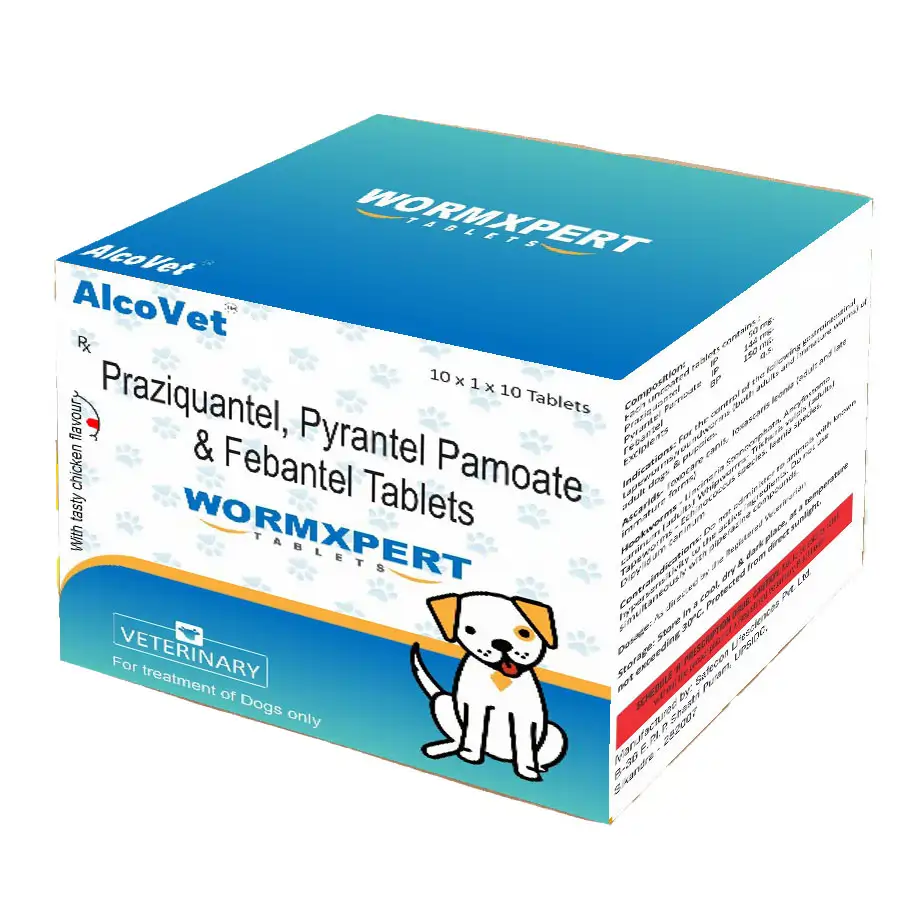
WormXpert
Praziquantel, Pyrantel Pamoate & Febantel Tablets — Broad-Spectrum Deworming for Adult Dogs
Overview & Clinical Rationale
Intestinal helminthiasis remains one of the most prevalent and clinically underdiagnosed conditions in adult dogs. Adult dogs in high-exposure environments — including outdoor dogs, multi-pet households, dogs in contact with livestock and hunting breeds — face ongoing risk from both nematode and cestode infections throughout their lives.
Subclinical parasitism in adult dogs contributes to poor body condition, reduced nutrient utilisation, chronic gastrointestinal disturbance and significant zoonotic risk to human contacts — particularly children and immunocompromised individuals — through environmental faecal contamination with parasite eggs.
Triple-Active Formulation — One Tablet, Complete Coverage
WormXpert combines three complementary anthelmintic agents — praziquantel (cestocidal), pyrantel pamoate (nematocidal — roundworms, hookworms) and febantel (nematocidal — whipworms, roundworms) — into a single tablet, providing comprehensive intestinal parasite control in a single oral dose at a convenient 1 tablet per 10 kg dosing schedule.
Mechanism of Action
Each active component targets intestinal parasites via a distinct mechanism — providing complementary action across all major helminth classes:
Praziquantel
Increases parasite cell membrane permeability to calcium, causing tetanic paralysis, tegumental disruption and rapid death of tapeworm segments. Active against Dipylidium, Taenia and Echinococcus spp.
Pyrantel Pamoate
Acts as a depolarising neuromuscular blocking agent, causing sustained spastic paralysis in susceptible nematodes. Primarily active against roundworms (Toxocara, Toxascaris) and hookworms (Ancylostoma spp.).
Febantel
Prodrug metabolised to fenbendazole and oxfendazole in vivo. Inhibits parasite tubulin polymerisation, disrupting microtubule assembly and glucose uptake — especially active against whipworms (Trichuris vulpis) and roundworms.
Target Parasite Spectrum (Adult Dogs)
Roundworms
Toxocara canis, Toxascaris leonina
Hookworms
Ancylostoma caninum, A. braziliense, Uncinaria stenocephala
Whipworms
Trichuris vulpis
Tapeworms
Dipylidium caninum, Taenia spp., Echinococcus spp.*
*Echinococcus coverage is an important zoonotic consideration. Frequency of treatment in at-risk dogs should be guided by veterinary assessment of local epidemiology.
Species & Life-Stage Restriction
- Not for puppies or juvenile dogs — separate formulations are available for younger patients
- Not for cats — febantel and pyrantel pamoate dosing and safety profiles differ by species
- Not for rabbits or other small animals — this formulation is species-specific for adult dogs
Indications
WormXpert is indicated for the treatment and prevention of mixed intestinal helminth infections in adult dogs in the following clinical scenarios:
- Routine scheduled deworming — of clinically healthy adult dogs at risk of intestinal parasitism
- Dogs with clinical signs of intestinal parasitism — weight loss, poor coat condition, chronic soft stool, scooting or visible proglottids
- High-exposure dogs — outdoor access, hunting breeds, farm dogs, dogs in contact with rodents or livestock
- Pre-vaccination deworming — to eliminate parasite-mediated immune suppression before vaccine administration
- Pre-breeding deworming — to reduce vertical transmission risk in bitches before mating
- Zoonotic risk reduction — in households with young children or immunocompromised individuals
- Shelter, boarding or multi-dog environments — where parasite load is elevated
ESCCAP Recommended Frequency
ESCCAP guidelines recommend deworming adult dogs with anthelmintics effective against both nematodes and cestodes at least 4 times per year (every 3 months). Dogs at elevated risk — hunting breeds, dogs regularly in contact with livestock or children, dogs with outdoor or coprophagic behaviour — may require monthly deworming. Schedule should be individualised by the treating veterinarian.
Contraindications & Precautions
Do Not Use In
- Puppies and juvenile dogs — not approved for this age group
- Cats — not appropriate for feline use
- Dogs with known hypersensitivity to any of the three active ingredients
- Severely debilitated dogs — stabilise clinical condition before deworming
- Pregnant or lactating bitches — use only on veterinary advice; safety data must be reviewed per component
- Concurrent anthelmintic therapy — avoid combining with other deworming agents without veterinary guidance
- Dogs on piperazine — pyrantel and piperazine have antagonistic mechanisms; do not co-administer
- MDR1/ABCB1 mutation (Collies and related breeds) — review safety profile of febantel metabolites under veterinary supervision before use
Dosage & Administration
| Body Weight (kg) | Dose | Route | Frequency |
|---|---|---|---|
| Up to 10 kg | 1 tablet | Oral — with or without food | As directed by veterinarian; minimum every 3 months |
| 10–20 kg | 2 tablets | ||
| 20–30 kg | 3 tablets | ||
| 30–40 kg | 4 tablets | ||
| >40 kg | As advised by veterinarian |
- Administer orally — tablets may be given directly or crushed and mixed into food
- Fasting is not required prior to administration
- For whipworm (Trichuris vulpis) — a 3-day treatment course or repeat dosing at 3 and 6 weeks may be advised by the veterinarian for heavy infections
- Store below 25°C in a cool, dry place, away from children
Full Monograph Available
Complete weight-based dosing tables, contraindication details and full PI sheet available on request. Download here
Composition & Pack Information
| Active Ingredients | Praziquantel; Pyrantel Pamoate; Febantel (per tablet — see product labelling for mg per tablet) |
|---|---|
| Formulation | Oral tablet — may be administered directly or crushed into food |
| Dose | 1 tablet per 10 kg body weight |
| Pack Size | 10 × 2 × 10 tablets (as shown on packshot) |
| Target Species | Adult dogs only |
| Not For | Puppies, cats, or other species |
| Storage | Store below 25°C in a dry place. Keep out of reach of children. |
| Availability | Veterinary channel only — to be sold on prescription of a Registered Veterinary Practitioner |
| Full Monograph | Complete dosing tables, PI sheet and safety data on request. Download here |
Frequently Asked Questions
What parasites does WormXpert treat?
Can WormXpert be given to puppies or cats?
What is the dose of WormXpert?
How often should adult dogs be dewormed?
Is WormXpert safe for pregnant or lactating dogs?
Scientific References
Clinical decisions should always be individualised by the treating veterinarian. References support the pharmacological and epidemiological basis of this formulation.
- 1 Bowman DD. Georgis' Parasitology for Veterinarians. 11th ed. Elsevier; 2021. Standard veterinary parasitology reference.
- 2 ESCCAP. Worm Control in Dogs and Cats. ESCCAP Guideline 01; 6th ed. 2021. Available at: esccap.org
- 3 Traversa D. Pet roundworms and hookworms: A continuing need for global worming. Parasites & Vectors. 2012;5:91. doi:10.1186/1756-3305-5-91 PMID: 22577965
- 4 Taylor MA, Coop RL, Wall RL. Veterinary Parasitology. 4th ed. Wiley-Blackwell; 2016. Anthelmintic mechanisms and parasite biology reference.
- 5 Dryden MW, Payne PA, Smith V. Treatment of Ancylostoma caninum, Uncinaria stenocephala and Trichuris vulpis infections in dogs. Vet Ther. 2007;8(4):224–232. PMID: 18183558
- 6 Montoya A, et al. Efficacy of a combination of praziquantel, pyrantel embonate and febantel against nematode and cestode infections in dogs. Parasitol Res. 1998;84(2):142-146. Provides specific clinical validation for the synergistic efficacy of the triple-active formulation found in WormXpert against a broad spectrum of intestinal parasites.
WormXpert is part of AlcoVet's Deworming portfolio — providing species-appropriate, life-stage matched intestinal parasite control for companion animals.
Full Deworming Portfolio