
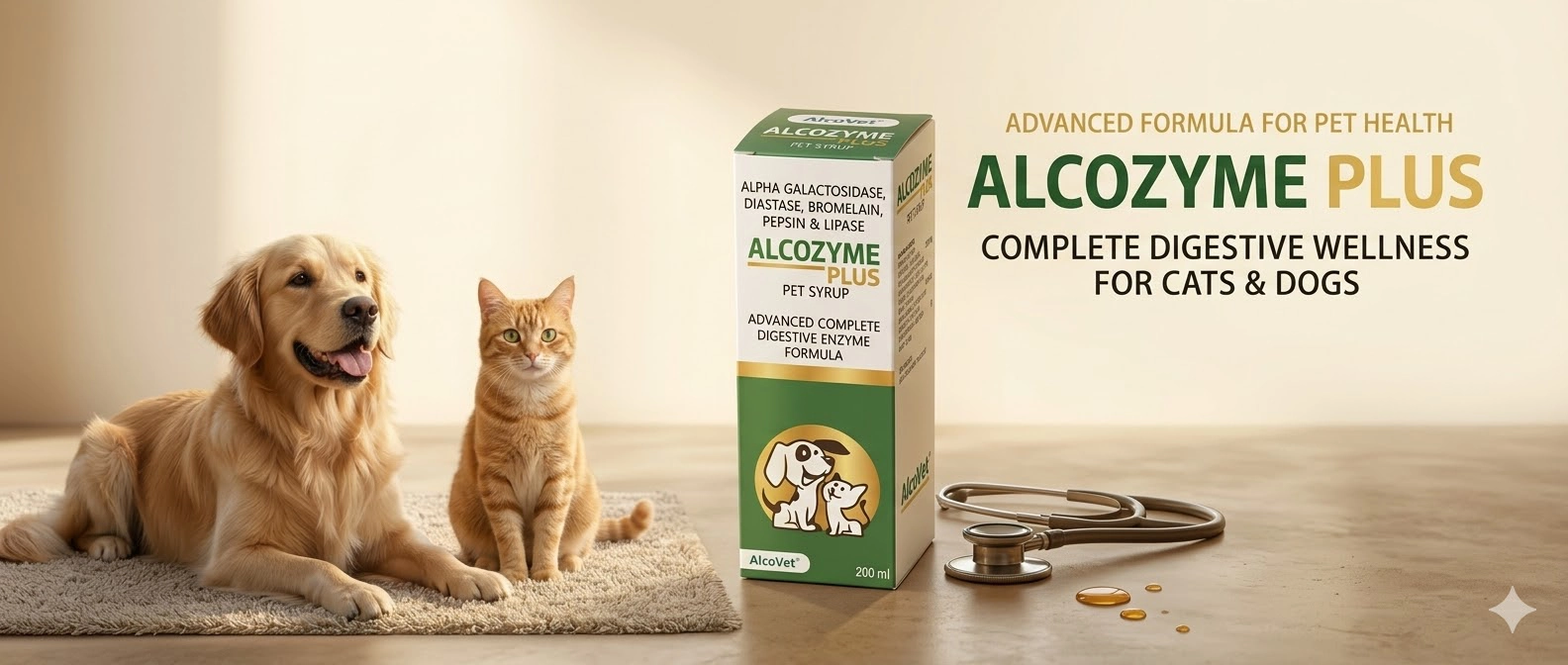
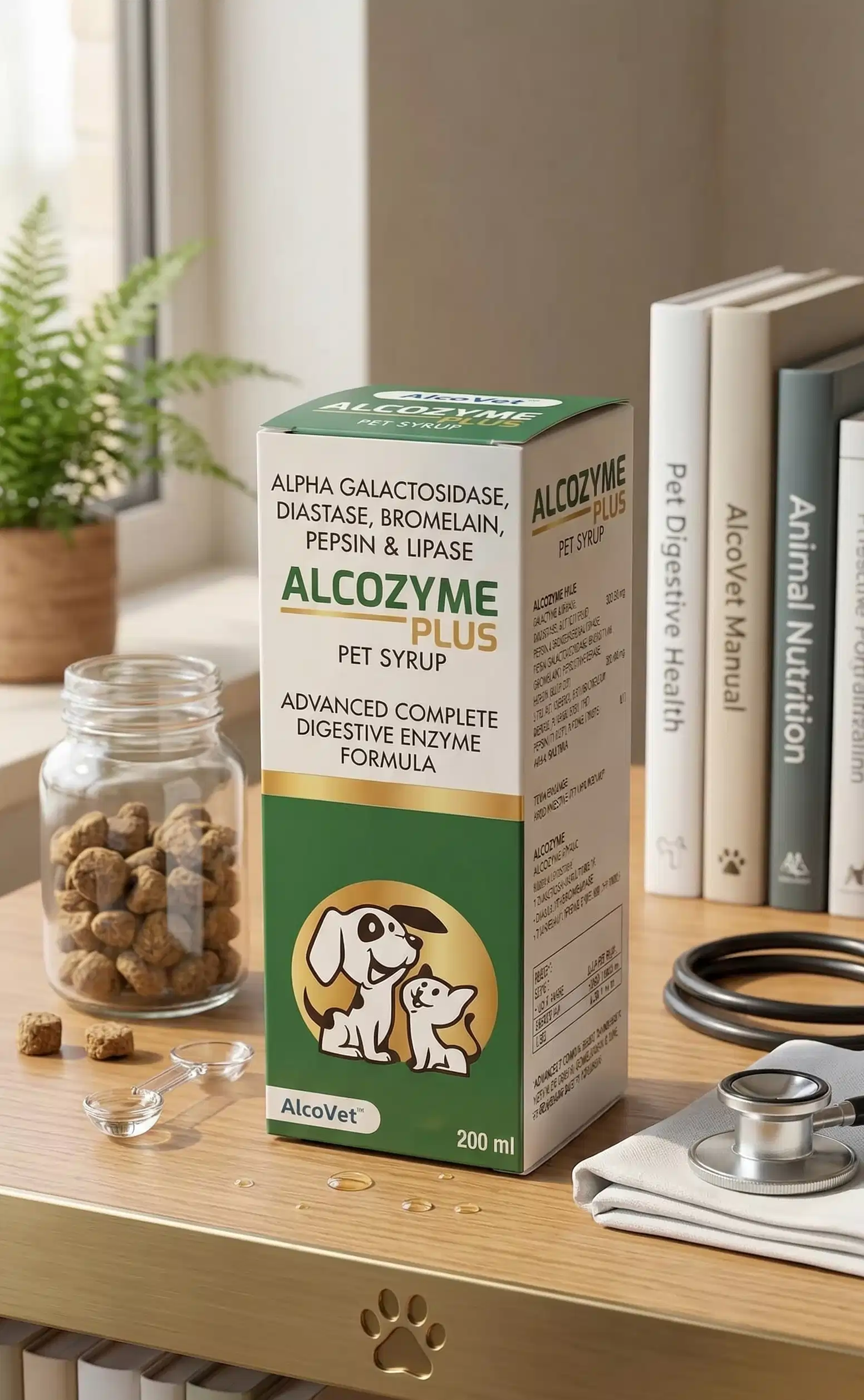
Alcozyme Plus
Advanced Complete Digestive Enzyme Syrup for Dogs & Cats
Overview & Clinical Rationale
Modern companion animal diets increasingly include diverse ingredients — plant proteins, legumes, complex carbohydrates and dietary fats — that demand a broader enzymatic repertoire than simple two-enzyme formulas can provide. When endogenous enzyme production is insufficient due to illness, exocrine pancreatic insufficiency (EPI), dietary complexity, inflammatory bowel disease or age-related decline, narrow enzyme coverage results in incomplete macronutrient breakdown, fermentation, gas, loose stools and poor nutrient bioavailability.
Alcozyme Plus is AlcoVet's advanced brand extension of Alcozyme, formulated with a five-enzyme complex — Alpha Galactosidase, Diastase, Bromelain, Pepsin and Lipase — to deliver complete macronutrient coverage across proteins, fats, starches and complex fermentable carbohydrates. It is indicated where standard dual-enzyme support is insufficient for the clinical presentation.
Advanced Brand Extension of Alcozyme
Alcozyme Plus builds on the proven Alcozyme franchise with three additional enzyme classes — Lipase (fat digestion), Alpha Galactosidase (complex carbohydrate and gas reduction) and Bromelain (anti-inflammatory protein digestion) — alongside Diastase for starch hydrolysis and Pepsin for gastric protein breakdown. Together, all five enzymes provide the most complete GI enzyme coverage in the AlcoVet range.
Position in the AlcoVet GI Therapy Ladder
Alcozyme Plus occupies Phase 1 — Stabilise (Complex) in the GI Therapy Ladder, selected for moderate-to-complex digestive insufficiency. It replaces Alcozyme in cases requiring full macronutrient coverage before Alcolyte Pro (Phase 2 — Restore) and OrexiGuard (Phase 3 — Rebuild) are introduced.
Stabilise
Alcozyme Plus — advanced enzyme support
Restore
Alcolyte Pro — rehydration & microbiome
Rebuild
OrexiGuard — appetite & nutrition recovery
GI Therapy Ladder — Phase 1 of 3
View the full Stabilise → Restore → Rebuild clinical framework and understand when to escalate from Alcozyme to Alcozyme Plus.
Enzyme Profile — 5-Enzyme Complex
Each enzyme in Alcozyme Plus targets a distinct substrate class, ensuring no macronutrient passes through the gut undigested. Together they form a complete digestive matrix covering all four macronutrient groups.
Cleaves alpha-galactosidic linkages in oligosaccharides (raffinose, stachyose, verbascose) found in legumes, plant proteins and complex multi-ingredient diets. Prevents fermentation of undigested carbohydrates in the colon — directly reducing gas, bloating and flatulence.
Hydrolyses starch and partially cooked or gelatinised carbohydrates into maltose and simple sugars for rapid intestinal absorption. Complements Alpha Galactosidase in delivering comprehensive carbohydrate digestion across both simple and complex substrates.
A pineapple-derived proteolytic enzyme that hydrolyses a broad range of dietary proteins at multiple cleavage sites. Also exerts clinically meaningful anti-inflammatory activity on the gut mucosa, supporting recovery in cases with underlying GI inflammation.
A gastric acid-stable protease that initiates protein breakdown in the acidic stomach environment by cleaving peptide bonds adjacent to aromatic amino acid residues. Works synergistically with Bromelain to provide staged protein digestion from stomach through the small intestine.
Catalyses the hydrolysis of dietary triglycerides into free fatty acids and monoglycerides. Critical for fat-soluble vitamin absorption (A, D, E, K) and caloric recovery from dietary fats. Especially important in EPI, post-pancreatitis recovery and patients on high-fat or recovery diets.
Alcozyme Plus vs Alcozyme — When to Escalate
Alcozyme and Alcozyme Plus both occupy Phase 1 (Stabilise) in the GI Therapy Ladder but differ in breadth and clinical indication. Use the table below to guide product selection.
| Parameter | Alcozyme | Alcozyme Plus |
|---|---|---|
| Enzymes | Alpha Amylase + Pepsin | Alpha Galactosidase + Diastase + Bromelain + Pepsin + Lipase |
| Macronutrient coverage | Carbohydrates + Proteins | Carbohydrates + Proteins + Fats + Complex Carbs / Oligosaccharides |
| Fat digestion (Lipase) | — | ✓ |
| Plant/legume carb support (Alpha Galactosidase) | — | ✓ |
| Anti-inflammatory protein digestion (Bromelain) | — | ✓ |
| Best for | Mild-acute GI cases, simple diets, straightforward post-GE recovery | Moderate-complex cases, EPI, IBD, multi-ingredient diets, fat malabsorption, post-pancreatitis |
| GI Ladder role | Phase 1 — Stabilise (Standard) | Phase 1 — Stabilise (Complex / Escalated) |
Clinical Indications
Alcozyme Plus is indicated as advanced digestive enzyme support in the following clinical scenarios:
- Exocrine Pancreatic Insufficiency (EPI) — comprehensive enzyme replacement covering all macronutrients including dietary fats; critical for full EPI management in dogs and cats.
- Fat malabsorption and steatorrhoea — Lipase component supports fat emulsification and absorption in patients with steatorrhoeic presentations.
- Multi-ingredient and plant-rich diets — Alpha Galactosidase addresses fermentable oligosaccharides from legumes, peas and plant proteins in complex commercial diets.
- Inflammatory Bowel Disease (IBD) with digestive insufficiency — Bromelain's anti-inflammatory action combined with full enzyme coverage supports mucosal recovery and nutrient uptake.
- Post-pancreatitis and pancreatic recovery — exogenous enzyme supplementation to bridge the period of reduced pancreatic output following acute or chronic pancreatitis.
- Chronic flatulence and bloating — Alpha Galactosidase reduces colonic fermentation of undigested carbohydrates, directly addressing gas production.
- Senior patients with multi-enzyme decline — age-related reduction in pancreatic, gastric and intestinal enzyme output addressed comprehensively by the 5-enzyme profile.
- Post-gastroenteritis complex recovery — where standard Alcozyme monotherapy has not achieved adequate GI stabilisation within 3–5 days.
- Dietary transition in sensitive patients — enzymatic adaptation support during diet changes, reducing transition-related GI upset in breeds with known dietary sensitivity.
Veterinary Guidance Required
Alcozyme Plus is a veterinary product. All indications should be confirmed by a licensed veterinarian. Chronic or recurrent GI signs should be investigated for underlying pathology before initiating enzyme therapy.
Usage & Administration
- Oral syrup — administer directly or mix into food, given immediately before or with meals
- Dosage adjusted by species, body weight, dietary fat content and clinical severity — refer to product labelling
- Compatible with concurrent probiotic and electrolyte therapy (Alcolyte Pro — GI Ladder Phase 2)
- In EPI and chronic pancreatic insufficiency, long-term ongoing use is appropriate under periodic veterinary review
- In post-pancreatitis recovery, continue until stable faecal consistency and appetite are re-established
- Palatable formulation — suitable for both dogs and cats; shake well before use
- Store in a cool, dry place below 25°C, away from direct sunlight
Regulatory & Channel Status
Alcozyme Plus is a veterinary recommendation product. For all clinical indications — acute or chronic — use under veterinary direction is recommended. Full weight-based dosing and full excipient composition are provided in the product monograph — Download here
Composition & Pack Information
Each 5 ml of Alcozyme Plus Pet Syrup contains:
| Active Ingredient | Enzyme Class | Substrate Target |
|---|---|---|
| Alpha Galactosidase | Glycoside Hydrolase | Oligosaccharides / Plant carbohydrates / Gas |
| Diastase | Malt Amylase | Starches / Cooked carbohydrates |
| Bromelain | Cysteine Protease (Plant) | Proteins / Anti-inflammatory |
| Pepsin | Aspartic Protease (Gastric) | Proteins — gastric phase |
| Lipase | Triacylglycerol Lipase | Dietary fats / Triglycerides / Fat-soluble vitamins |
| Formulation | Palatable oral syrup |
|---|---|
| Route | Oral — direct or mixed with food |
| Pack Size | 200 ml bottle |
| Target Species | Dogs & Cats |
| Storage | Store below 25°C; protect from sunlight; shake well before use |
| GI Ladder Position | Phase 1 — Stabilise (Complex / Escalated) |
| Availability | Veterinary recommendation — use under professional guidance |
| Full Monograph | Quantitative dosing, full excipient list and stability data available on request. Download here |
Frequently Asked Questions
What is Alcozyme Plus and how does it differ from Alcozyme?
What does each enzyme in Alcozyme Plus do?
When should a vet choose Alcozyme Plus over Alcozyme?
Can Alcozyme Plus be used long-term in EPI patients?
Can Alcozyme Plus be used with Alcolyte Pro and OrexiGuard?
Is Alcozyme Plus safe for cats as well as dogs?
Selected References
References support the scientific basis of this formulation. They do not constitute clinical recommendations. All therapeutic decisions should be made by a qualified veterinarian.
- 1 Steiner JM. Exocrine pancreatic insufficiency in dogs and cats. Vet Clin North Am Small Anim Pract. 2012;42(2):355–367. doi:10.1016/j.cvsm.2012.01.006
- 2 Spillmann T. Exocrine pancreatic insufficiency in cats. Topics in Companion Animal Medicine. 2020. PubMed
- 3 Borda LJ, Wikramanayake TC. Bromelain — a literature review and discussion of its therapeutic applications. J Dermatol Dermatolog Surg. 2014. (Protease activity and anti-inflammatory properties).
- 4 German AJ. Chronic intestinal malabsorption in cats. Journal of Feline Medicine and Surgery. 2009;11(1):49–57.
- 5 Suarez FL et al. Reduction of intestinal gas following the consumption of legumes treated with Alpha Galactosidase. Am J Gastroenterol. 1999. (Alpha Galactosidase mechanism reference).
- 6 Simpson KW, Jergens AE. Pitfalls and progress in the diagnosis and management of canine inflammatory bowel disease. Vet Clin North Am Small Anim Pract. 2011;41(2):381–398. doi:10.1016/j.cvsm.2011.01.001
- 7 Wiberg ME, Nurmi AK, Westermarck E. Responses of dogs with exocrine pancreatic insufficiency to enzyme replacement therapy. Am J Vet Res. 1998;59(12):1503-1507. Demonstrates the necessity of broad-spectrum exogenous enzyme replacement, particularly lipase, in restoring nutritional status in EPI.
- 8 Guilford WG, Center SA, Strombeck DR, et al. Strombeck's Small Animal Gastroenterology. 3rd ed. Philadelphia: WB Saunders; 1996. Foundational text validating the staged physiological breakdown of macronutrients, supporting the rationale for multi-phase enzymes like pepsin (gastric) and bromelain/pancreatic enzymes (intestinal).
Also in the Gastro Care Range
Alcozyme Plus is Phase 1 — Stabilise (Complex) in AlcoVet's GI Therapy Ladder. Continue to Phase 2 (Alcolyte Pro) for rehydration and microbiome restoration.