
Cat aggression is the second most common reason cat owners seek veterinary behavioural help, after elimination problems. It is also one of the most misunderstood — because the popular image of cat aggression is of an unpredictable, malicious attack, when the reality is that almost all cat aggression is entirely predictable once you understand its mechanism. Cats do not attack randomly or out of spite. Every aggressive act is either a communication that a threshold has been reached, a response to something the cat has identified as a threat, an expression of frustration, or a signal that something physically painful is happening that the cat cannot otherwise convey.
The practical implication of this is important: if you can identify which mechanism is operating, you can address the cause rather than just reacting to the behaviour. A cat that is biting during petting needs a different response than a cat that is redirecting territorial arousal onto a household member. A cat whose aggression started suddenly in middle age needs a pain assessment, not a training programme. Getting the mechanism right is the prerequisite for any effective management.
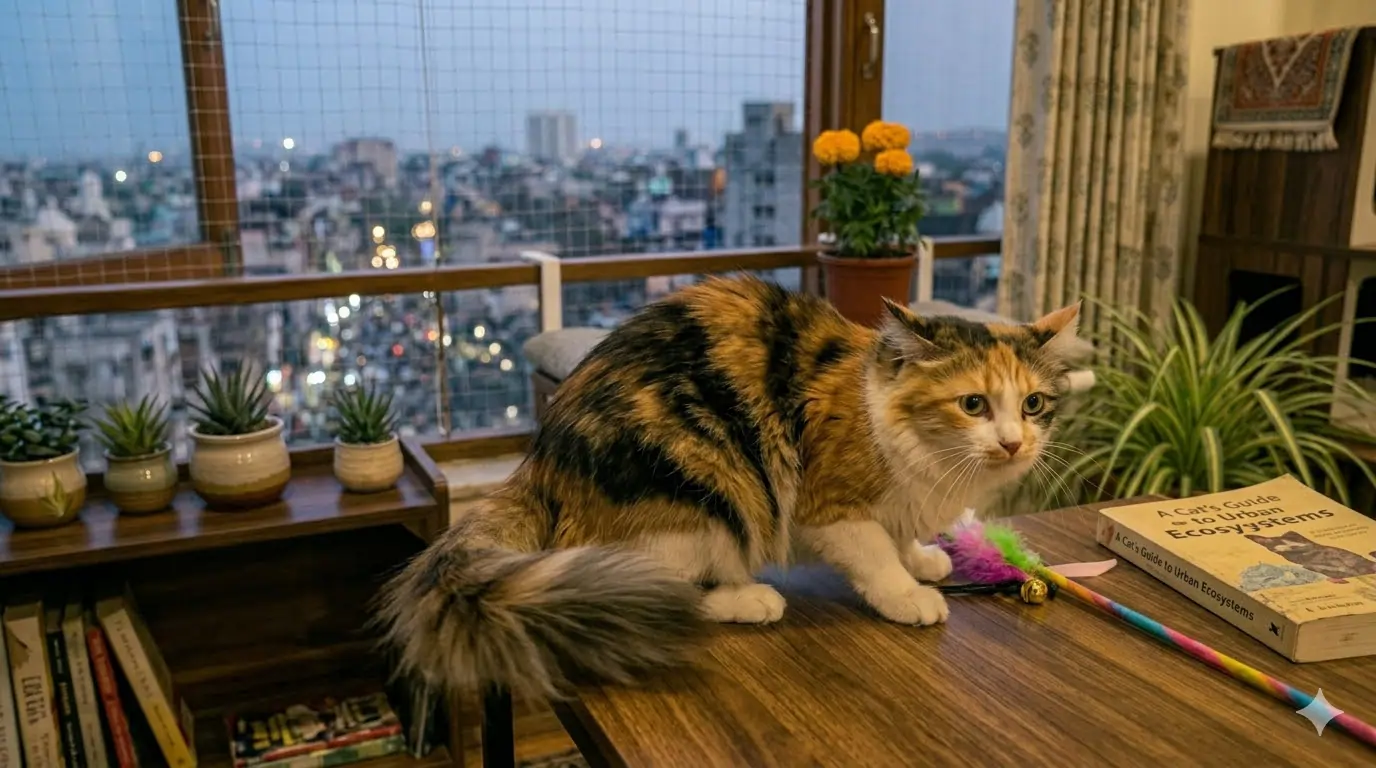 The warning sequence before an aggressive act is almost always visible if you know what to look for. The cat communicating discomfort through body language is not the same cat as one that has crossed into aggression — the space between those two states is where every intervention should happen.
The One Thing That Changes Everything: Aggression Is Always Communication
Every form of cat aggression — hissing, growling, swatting, biting, scratching — is a communication act. It is not malice, not spite, not "dominance," and not a personality defect. It is a cat that has run out of other ways to communicate something. The hiss and the growl are explicit warnings: I am uncomfortable, I am frightened, this is hurting me, I need you to stop or move away. The scratch or the bite is what happens when those warnings are ignored, suppressed, or simply not understood.
This framing has a direct practical consequence: punishing aggression silences the warning signal without addressing the underlying state. A cat that is punished for hissing does not become less fearful, less overstimulated, or less in pain — it becomes a cat that no longer warns before it bites. This is clinically described as a cat that "attacks without warning," and it is almost always a cat whose warnings were previously punished out of existence. The hissing cat is telling you something useful. The approach that serves both the cat and the owner is: hear the communication and act on it, rather than suppressing the signal.
Types of Cat Aggression by Mechanism
Fear Aggression
The most common form of cat aggression overall. The cat perceives a threat — a person, another animal, a new object, a sudden sound — and when its first-choice response (flee) is blocked, aggression becomes the only available option. Characteristic body language: crouched posture, arched back (making the cat appear larger), tail curved around body or lashing, ears flat, pupils maximally dilated. The cat is not attacking because it wants to fight — it is attacking because it feels it has no other way out. Management: remove the trigger, provide an escape route, never corner a fearful cat or approach it head-on.
Play Aggression
Predominantly a kitten and young-cat problem. The predatory motor sequence — stalk, pounce, bite, kick — is directed at human hands, feet, and ankles rather than appropriate prey objects, because the cat was either never provided with appropriate play targets or learned that humans are interactive prey through hand-play in kittenhood. The bites and scratches are genuine but the intent is play rather than threat — the cat's body language is bouncy and excited rather than tense and defensive. Management: never use hands as play objects; redirect immediately to a wand toy at the first sign of hunt-stalk behaviour directed at a person; two daily structured play sessions to provide an appropriate outlet for predatory energy.
Petting-Induced Overstimulation
The most common form of aggression toward owners and the one most consistently described as "out of nowhere." It is never out of nowhere — the cat has been displaying escalating signals for the entire preceding interaction that were either not noticed or not acted on. See the deep-dive section below for the full signal sequence and intervention protocol. The mechanism involves a cat whose tactile arousal threshold has been exceeded — what begins as pleasurable sensation becomes noxious stimulus, and the cat bites to end the contact. Management: learn the pre-bite signals, end the petting session before they appear, never extend petting past early warning signs.
Redirected Aggression
One of the most dangerous and most poorly understood forms of cat aggression. The cat is in a state of high arousal triggered by something it cannot reach or act on — a stray cat visible through the window, the sound of an outdoor cat, fireworks, a passing dog. The arousal has nowhere to go and is redirected onto the nearest available target — typically a household member or other cat that approaches during the arousal state. The victim has done nothing to trigger the aggression and the apparent "unprovoked attack" is not connected to the immediate interaction at all. See the dedicated section below.
Inter-Cat Aggression
Aggression between cats within the same household — one of the most common welfare problems in multi-cat Indian apartments. Two distinct types with different management approaches: offensive (one cat consistently initiating, chasing, and pinning the other — social incompatibility) and defensive (mutual escalation when resources are insufficient or territories overlap). Spraying, blocking access to litter boxes, routing the subordinate cat away from food, and sustained vigilance posture in the subordinate cat are signs that the relationship has deteriorated beyond manageable tension. See the inter-cat section below for the full re-introduction protocol.
Pain-Mediated Aggression
Sudden-onset aggression in a previously calm cat, or a cat that has become aggressive specifically when touched in a certain body area, is a pain presentation until proven otherwise. Common sources in Indian cats: dental disease (the most under-recognised cause — a cat with severe periodontal pain may bite when its head is touched), arthritis in senior cats (aggression when the lower back, hips, or limbs are touched), hyperthyroidism (dramatically lowers arousal threshold in older cats), FIC flare (abdominal sensitivity), and undetected injuries. Any adult cat with new-onset aggression that is not explained by an obvious environmental change requires veterinary examination before any behavioural management is attempted.
Territorial Aggression
Cats are territorial animals and the scent landscape of their home is actively maintained. Territorial aggression is triggered by perceived intrusions — a new cat introduced without proper protocol, the smell of a vet clinic on a recently returned housemate (non-recognition aggression — the returning cat smells wrong), or a new person moving in. Classic presentation: a cat that was previously tolerant of a housemate suddenly attacks it after one of them returns from a vet visit. The attacking cat is not recognising the returning cat as its familiar companion — the smell of the clinic, the stress hormones, and the altered scent profile trigger a territorial response. Management: re-introduction protocol as if the cats are meeting for the first time; vanilla extract on both cats' chins briefly to equalise scent profile.
Maternal Aggression
A queen (intact female) with a litter will aggressively defend her kittens from any perceived approach — including from familiar humans. This is hormonally driven and entirely normal. It resolves naturally as the kittens become older and more independent (typically by 4–6 weeks). Management: do not handle kittens in the mother's presence in the first 2 weeks unless necessary; approach the nest slowly, calmly, and with minimal disturbance; allow the mother to smell your hand before touching kittens if handling is required. Aggression is significantly reduced if the queen has an established relationship with the handler — a cat that trusts you before pregnancy will typically allow brief handling of her kittens within the first week.
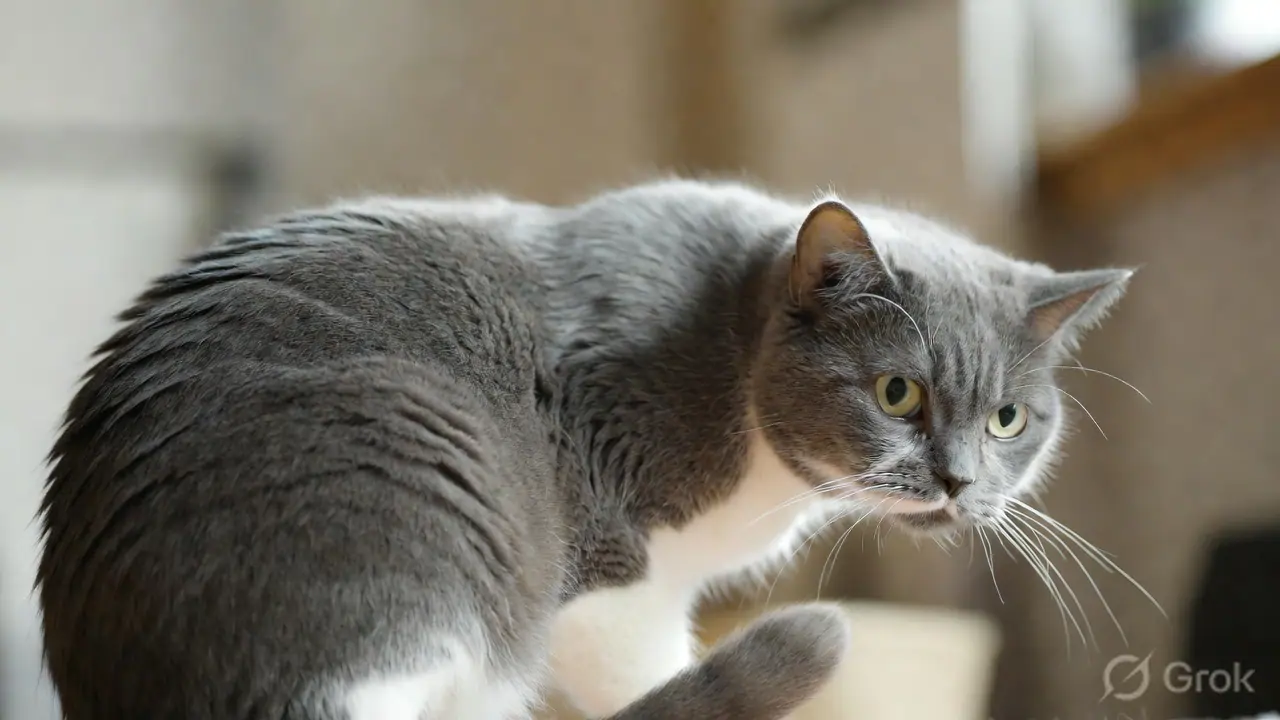 The skin ripple along the back and the beginning of tail movement are the early signals of petting overstimulation — visible 30–60 seconds before the bite threshold is reached if the petting continues. These are the signals that most owners have learned to miss.
Petting-Induced Overstimulation — The Complete Signal Sequence
Petting-induced overstimulation bites are the most commonly reported form of owner-directed aggression in cats. They are also the form most often described as unprovoked, when in reality the cat has communicated its discomfort through a sequence of increasingly obvious signals for the entire duration of the interaction. The reason the bite feels sudden is that owners typically notice the signals only in retrospect, after they have learned what to look for. Once you know the sequence, the bite becomes entirely predictable — and entirely avoidable.
| Signal | What It Looks Like | What It Means | Correct Response |
|---|---|---|---|
| Skin ripple | A visible wave of muscle contraction along the back — the skin twitches or "crawls" under the coat | Tactile sensitivity threshold is being approached — the touch is beginning to register as aversive rather than pleasant | Stop petting immediately. This is the earliest reliable warning signal. |
| Tail tip flick | The tip of the tail begins small, rhythmic flicks — not a full tail lash yet, just the end moving | Arousal is rising; the cat is monitoring the situation while beginning to express tension | Stop petting. Do not attempt "just one more stroke." |
| Ear rotation | One or both ears begin to rotate sideways or backward — no longer forward-relaxed | Attention is redirecting from relaxation to assessment; sensory systems are shifting to heightened monitoring | Stop and withdraw your hand slowly — no sudden movement. |
| Head turn toward hand | The cat turns its head to look at your hand — it may watch your hand without biting yet | The cat is directly attending to the contact point; this is deliberate consideration of the hand as a target | Stop petting and begin to disengage. Do not interpret as curiosity. |
| Cessation of purring | If the cat was purring, it stops — sudden silence | The positive state that accompanied the initial petting has ended; purring is no longer appropriate to the cat's current state | Disengage petting session — the cat has signalled that it has had enough. |
| Muscle tension / stillness | The cat's entire body becomes subtly more tense — the loose, soft posture of a relaxed cat replaced by a rigid, coiled quality | The cat is preparing to act; motor preparation for bite or scratch is underway | Withdraw hand immediately and smoothly. Do not hold the cat down. |
| Full tail lash | Vigorous, sweeping lash of the whole tail — unmistakable and large | Bite is imminent. The cat has passed through early warning into active preparation. | Remove hand immediately. If bitten at this stage, the bite was predictable. Do not punish. |
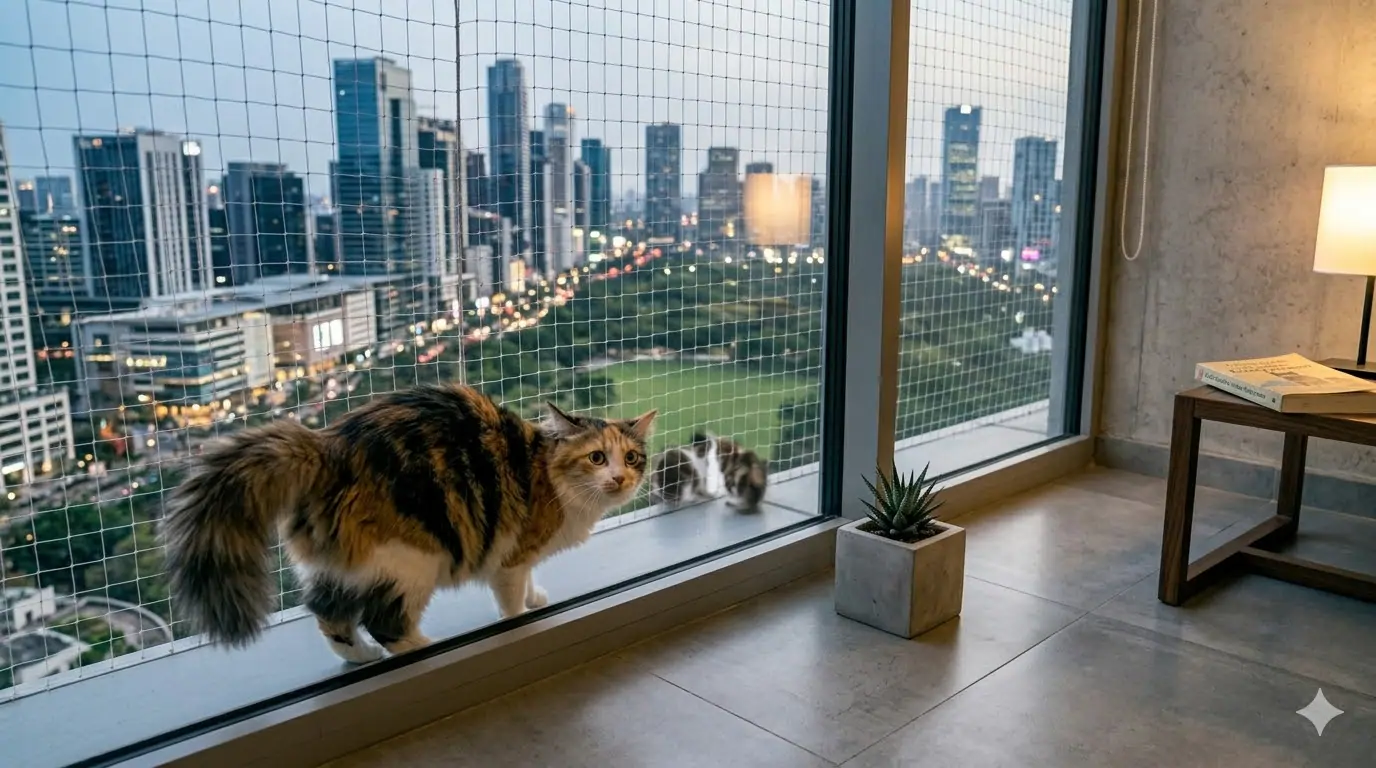 A cat that is staring out the window at a stray cat with a lashing tail, vocalising, and pressed flat against the glass is in a state of high arousal that does not end the moment the stray moves away. The redirected aggression risk window typically extends 20–30 minutes after the triggering event ends.
Redirected Aggression — The Most Dangerous and Most Misunderstood Form
Redirected aggression is the form of cat aggression most likely to result in serious injury, most likely to be misidentified as unprovoked, and most likely to permanently damage the relationship between the cat and its owner if the mechanism is not understood. In India's context — where apartment cats have regular visual access to strays on adjacent rooftops and balconies, where Diwali and festival noise creates sustained arousal states, and where high-density living produces frequent proximity to neighbourhood cats at windows — redirected aggression is a particularly common and practically significant problem.
The mechanism is straightforward: the cat perceives something highly arousing and threatening (a strange cat, loud noise, a dog, an unfamiliar person at the door) and enters a state of high physiological arousal. The triggering stimulus may be inaccessible — the stray cat is outside, the fireworks are outside, the loud visitor left. But the arousal state does not immediately resolve. The cat remains in a state of heightened activation for minutes to tens of minutes after the trigger is no longer present. During this window, any approach by a person or housemate cat activates the arousal that was meant for the original trigger. The blameless approaching person receives a full-force attack from a cat that, moments ago, was simply watching out the window.
The key temporal point: redirected aggression most often occurs 5–30 minutes after the triggering event, not during it. A cat that is hissing at the window is in the active arousal phase — most owners instinctively know not to touch it. The danger is the cat that has stopped hissing and appears to have settled, but has not yet returned to baseline arousal. This cat looks calm but is still activated, and the first person who approaches it without understanding the recent history receives the full redirected response.
Management protocol: If you observe your cat in a state of high arousal (staring fixedly at a stray, vocalising at the window, responding to fireworks), do not approach, touch, or attempt to soothe the cat for at least 20–30 minutes after the visible arousal behaviour ends. Leave the cat to deactivate independently. If you must move the cat away from the trigger (to close a window, for example), use a cardboard barrier to separate yourself from the cat or use a thick towel — do not use bare hands. Confine the aroused cat to a separate room if there are other cats in the home who might approach during the arousal window, triggering an inter-cat attack that can set back the household relationship by weeks.
Inter-Cat Aggression — Re-Introduction When the Relationship Has Broken Down
A multi-cat household where the cats are actively fighting, where one cat is consistently blocking the other from resources (food, litter, resting spots), or where one cat lives in a permanent state of hypervigilance to avoid the other, is a household with a genuine welfare problem for both animals. Many owners wait too long to intervene, hoping the cats will "sort it out." Active, sustained inter-cat aggression does not self-resolve — it typically escalates or reaches a stable but miserable equilibrium where the subordinate cat lives in chronic stress. The time to intervene is when the pattern is clear.
-
1
Separate completely — remove visual access, not just physical access. Put the cats in separate parts of the home with a closed door. A door gap or visual contact through a gate maintains the arousal state and does not constitute genuine separation. Each cat needs its own litter box, food and water, sleeping area, and vertical space in its section. This is not a brief "time out" — it is a full reset that may take 1–4 weeks before re-introduction begins. If the relationship has deteriorated severely, do not rush this phase.
-
2
Scent exchange before visual re-introduction. Swap bedding between the two cats' spaces so each is exposed to the other's scent without the pressure of direct contact. Feed each cat near the closed door between their spaces — high-value food in proximity to the other cat's scent builds a positive association with the other cat's smell. This phase typically takes 1–2 weeks. If either cat growls, hisses, or stops eating near the door, reduce the proximity and slow the timeline.
-
3
Visual contact through a barrier — a cracked door or baby gate. Once scent exchange is comfortable (both cats eating and behaving normally near the closed door), introduce visual contact through a slightly opened door or a baby gate — with feeding on both sides simultaneously. The goal is for both cats to see each other while engaged with high-value food. Short sessions (5–10 minutes) to start. Any sustained staring, vocalising, or aggressive body language means the session ends — go back to scent-only exposure for another few days.
-
4
Unsupervised shared space — only when both cats are consistently relaxed during supervised sessions. Supervised shared time, with the option to separate instantly if tension arises. Never leave recently re-introduced cats alone until there have been multiple calm shared sessions with no posturing, chasing, or vocalising. Keep sessions short initially — 15–30 minutes. Extend as confidence builds. The re-introduction is not complete until both cats can eat, rest, and move through shared space without sustained vigilance or avoidance behaviour from the subordinate cat.
-
5
Address resource competition permanently. Inter-cat aggression in multi-cat homes is frequently sustained by resource scarcity — insufficient litter boxes, a single feeding station where one cat can monopolise food, or too few resting spots to allow both cats to rest comfortably without being within visual range of each other. The rule of N+1 (one more of each resource than the number of cats) is the standard — two cats need three litter boxes in different locations, multiple feeding stations, multiple water sources, and enough vertical space for each cat to have a claimed high point. Resource provision does not guarantee relationship improvement, but resource scarcity guarantees continued conflict.
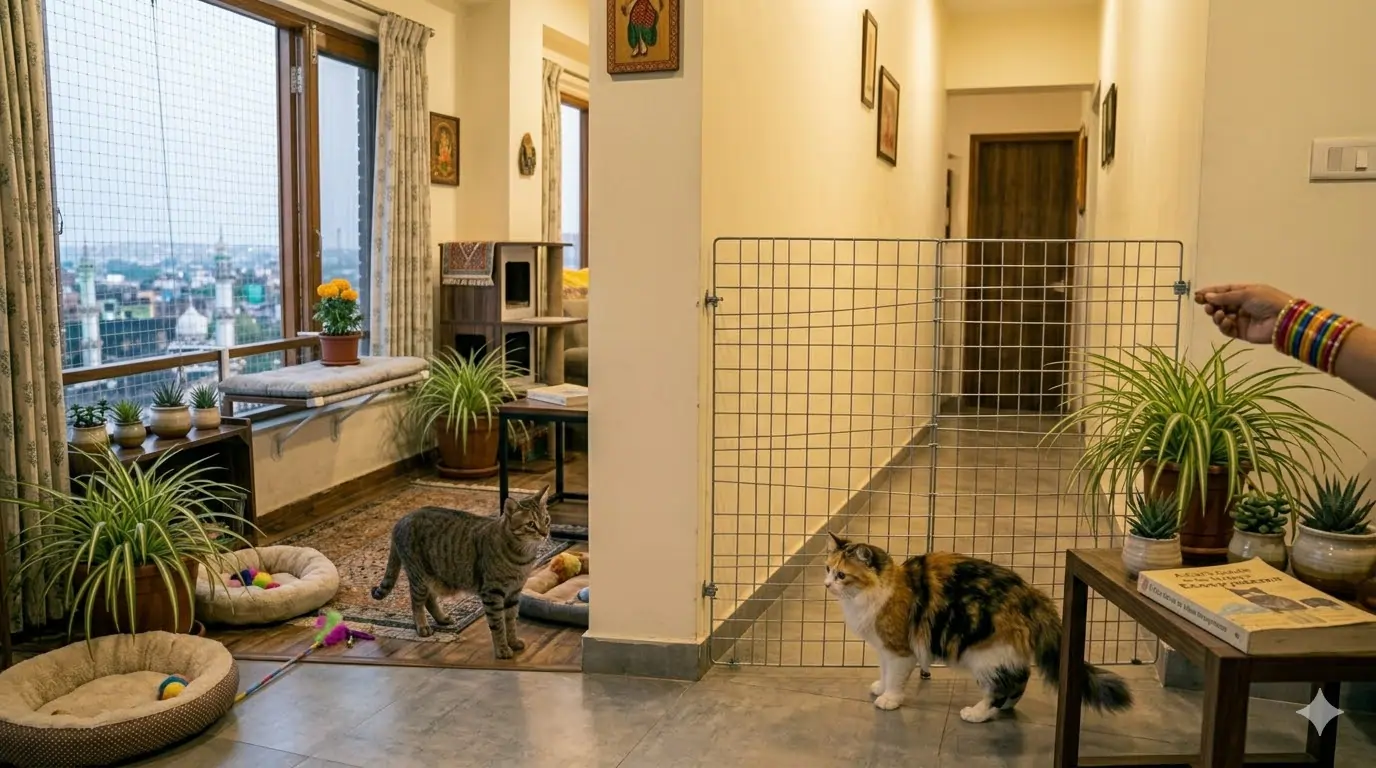 A baby gate with visual contact during a parallel feeding session is Stage 3 of the re-introduction protocol — positive association with seeing the other cat, built slowly, replaces the negative association that sustained fighting had created. Both cats are at safe distance with a physical barrier between them.
Play Aggression in Kittens — Causes and the Correct Response
Play aggression in kittens and young cats is the predictable consequence of a specific early socialisation error: allowing kittens to treat human hands and feet as play targets. This usually begins in the first weeks of ownership when a kitten chasing and biting a hand is endearingly small and not painful. By four months, the same behaviour from the same cat is significantly less endearing and considerably more painful. By adulthood, a cat that has always been played with using hands has a deeply ingrained motor pattern associating human limbs with prey — and genuine behavioural modification is more complex than prevention would have been.
The correct response at every stage of play aggression — kitten or adult — is consistent and immediate: freeze, withdraw, disengage. Do not yelp, jerk away, push the cat off, or bat at it — all of these responses escalate the play sequence (the prey is responding, which is exactly what the cat wants). Simply become inert and uninteresting the instant teeth or claws make contact. Stand up and walk away if withdrawal of the target body part is insufficient. Then immediately redirect to a wand toy to provide an appropriate prey target. The message is consistent: hands are not prey objects; this toy is the prey object.
Play aggression that is not effectively redirected by 12–18 months of age, or that includes behaviours that exceed play intensity (breaking skin routinely, directed at specific people, accompanied by non-play body language), should be assessed by a veterinarian to rule out pain, hormonal factors in intact cats, and to determine whether a veterinary behaviourist referral is appropriate.
What Never to Do — Actions That Consistently Make Aggression Worse
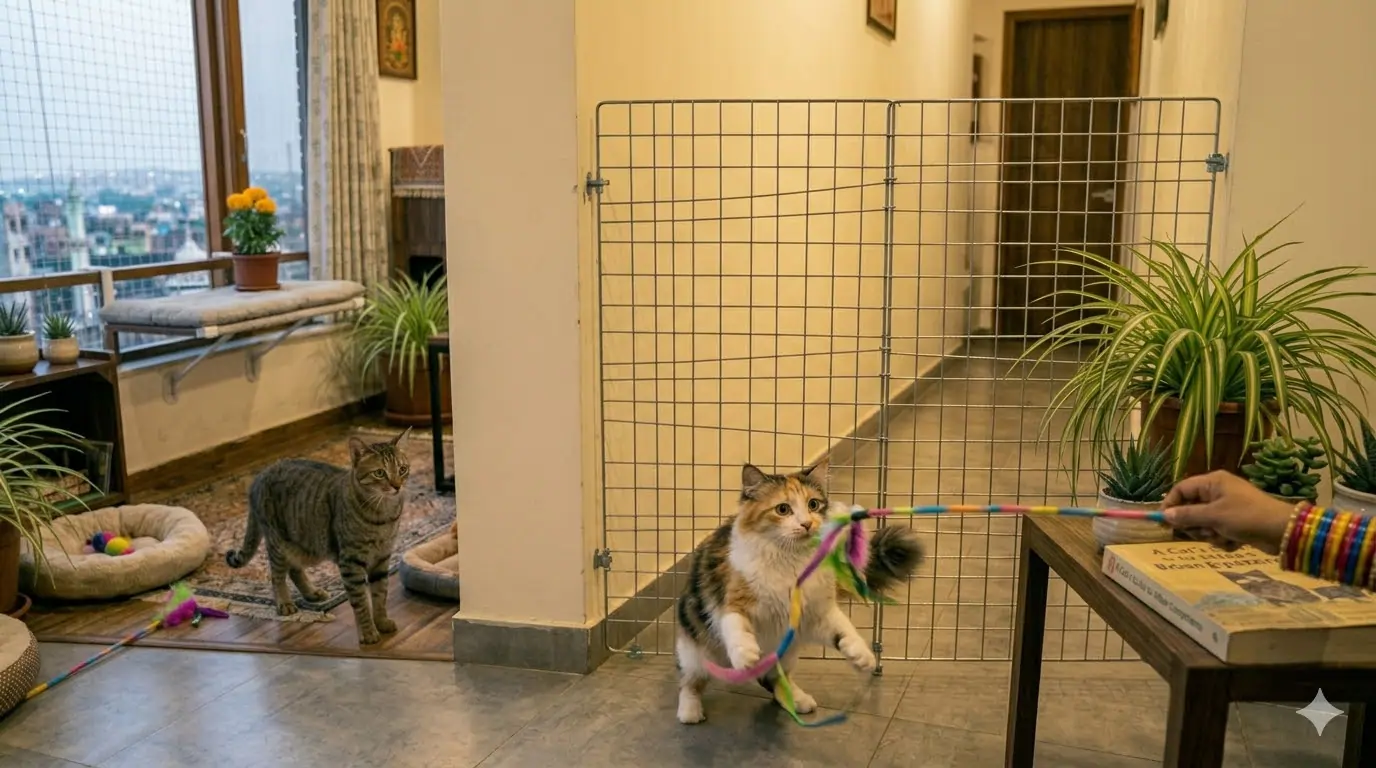 The moment play aggression is directed at a hand — freeze, withdraw, redirect to a wand toy. Consistency of this response, from every person in the household, is what eventually establishes the distinction between unacceptable prey (hands) and acceptable prey (toys).
India-Specific Aggression Triggers
When to Seek Veterinary or Behaviourist Help
Most cat aggression cases are manageable with the understanding and protocols outlined in this guide. However, some situations require professional input — either because a medical driver needs to be identified and treated, or because the complexity and severity of the behavioural problem exceeds what self-management can safely address.
Seek veterinary assessment for any aggression that is: new-onset in a previously calm adult or senior cat; specifically located (triggered by touching one body area); accompanied by other behaviour changes (reduced appetite, altered litter box use, increased hiding, changes in activity level); in a cat that is also showing signs of illness; or that has escalated rapidly in severity without an obvious environmental explanation. These presentations may have a medical driver — pain, hyperthyroidism, neurological disease, or FIC — that must be addressed before any behavioural intervention will be effective.
Seek a veterinary behaviourist or certified feline behaviour consultant for: inter-cat aggression that has not responded to 6–8 weeks of structured re-introduction; human-directed aggression severe enough to cause injury; a cat whose aggression is severely impacting quality of life for the cat or household members; any aggression with a neurological or complex medical context. In India, veterinary behaviourist access is limited but growing — specialist consultations are available at some veterinary teaching hospitals (IVRI Bareilly, Bombay Veterinary College, TANUVAS Chennai) and through a small number of independent certified behaviourists who offer remote consultations for cases that cannot travel.
Related Guides
This content is provided for educational purposes only and is not a substitute for professional veterinary advice. Any cat bite that breaks the skin requires thorough immediate washing and same-day medical assessment — cat bite wounds have high infection rates due to Pasteurella and anaerobic bacteria, and any bite from a cat of unknown or lapsed vaccination status requires assessment for rabies post-exposure prophylaxis. New-onset aggression in an adult cat requires veterinary examination before any behavioural management is attempted.