
The majority of cats kept as companions in Indian cities live in apartments. A 2BHK or 3BHK flat in Mumbai, Bengaluru, Delhi, or Hyderabad is the modal Indian cat habitat — a space that, depending on the building, may be 600 to 1,200 square feet, located on any floor between 1 and 30, subject to noise from neighbours above, below, and on both sides, and shared with anywhere from one person to a joint family of eight. It is also frequently the same space where agarbatti is lit daily, where a full-time domestic worker moves through every morning, where children visit on weekends, and where Diwali turns the acoustic environment into something a cat's auditory system never evolved to process.
Generic cat care advice — the kind produced in the UK or the US — deals with none of this. It discusses "creating a cat room" in a house with six rooms. It recommends "placing the cat in a quiet space" during stressful events, without addressing what to do when the entire building is releasing fireworks simultaneously. It mentions "introducing cats to children" without accounting for the reality of a joint family where eight children arrive every Diwali.
This guide is written for the specific context of Indian apartment life. Every section addresses a reality that is common to Indian cat-owning households but absent from most generic cat care resources. The goal is a practical, India-specific framework for giving a cat a genuinely good quality of life within the real constraints of Indian urban living.
 Window access transforms an apartment for a cat. The movement of traffic, birds, people, and the outdoor world provides hours of passive stimulation that a bare wall never can. A window perch at the right height costs very little and changes the cat's relationship with its entire space.
Designing Territory in a Compact Indian Apartment
A cat does not experience its home as square footage. It experiences it as a three-dimensional network of territories — zones with different functions, different security levels, and different social associations. In the wild, this network spans hectares. In a 2BHK apartment, it spans perhaps 70 square metres of floor space. The question is not whether the space is large enough — cats have lived contentedly in small spaces for thousands of years — but whether the space has been designed to meet the cat's core territorial needs: high refuge, private retreat, observation posts, ownership zones, and safe feeding/elimination locations with adequate separation.
🔼 Vertical Territory — The Height Imperative
Cats experience height as security and status. A cat that can access the highest point in a room has a clear visual field in all directions and cannot be approached unseen from above — the optimal safety position for a prey-aware predator. In an Indian apartment without vertical structure, cats attempt to access wardrobes, refrigerator tops, bookshelves, and kitchen shelves — often causing damage and frustration in the process. The solution is not to block these access points but to provide sanctioned high territory: a cat tree with a top platform at or above human eye level, wall-mounted shelves at multiple heights, or a dedicated high perch near the window. Vertical space effectively multiplies usable territory without requiring any additional floor area — the single highest-value investment for a small apartment cat.
🪟 Window Perches — Passive Enrichment
A window is a television that never repeats content. Birds, crows, kites, squirrels, lizards on exterior walls, the movement of people and vehicles below, rain on glass — all of this constitutes hours of daily passive stimulation that would otherwise simply not exist for an indoor cat. Mount a stable window perch or cat hammock at the window the cat already gravitates toward. In Indian high-rises, ensure the perch is installed at a window with a screen or grille that can contain the cat if it becomes excited — an open window with no barrier on a high floor is a fall risk that has claimed many indoor cats. The perch itself should be stable enough to support an adult cat shifting its weight excitedly without tipping.
🔒 Private Retreat — Non-Negotiable
Every cat in an apartment needs at least one location that is always accessible, always quiet, and never entered by visitors, children, or domestic staff. This is the cat's decompression zone — the place it can retreat to when the apartment has visitors, when the festival is too loud, when the domestic worker vacuums, when the toddler is visiting. This space does not need to be large — a quiet bedroom with the door kept ajar, a space under a bed with a soft bed placed there, or a dedicated cat room if the apartment allows. What it must be is consistently available and consistently respected by all household members and visitors.
🍽️ Feeding and Elimination Separation
Cats have a strong instinctive aversion to eating near where they eliminate — an evolutionary sanitation response. In small apartments where space is limited, the temptation is to place the food bowl and litter box near each other for convenience. This consistently produces reduced food intake or reduced litter box use, depending on which the cat prioritises avoiding. Place food, water, and litter box in genuinely separate locations — different rooms where possible, or at opposite ends of the same room at minimum, with enough distance that the cat does not perceive them as the same zone. The litter box should be in the least socially trafficked part of the apartment, accessible 24/7, and never placed in a cupboard or enclosed space that the cat must be let into on request.
🛋️ Ownership Zones and Scent Marking
Cats mark territory through facial rubbing (bunting), scratching, and scent deposition. An apartment cat that is rubbing its face on furniture, doorframes, and personal objects is establishing its scent signature throughout its territory — a healthy, normal behaviour that indicates the cat is comfortable claiming the space. Scratching posts and pads placed at territorial boundary points (near the main door, near windows, at room transitions) redirect natural scratch-marking to appropriate surfaces. A cat that is given sanctioned scratching surfaces in the right locations does not need to scratch sofas — it scratches posts because posts are placed where the scratching drive is activated, not because it has been "trained" not to scratch furniture.
🚪 Door Management in Multi-Room Apartments
In a 2BHK or 3BHK apartment, room access determines how much territory the cat can use. A cat confined to one room while family members occupy the others is living in a significantly smaller territory than the apartment's actual size. Where possible, allow the cat free movement between all rooms during the hours family is home — this maximises territory, provides choice of microclimate (cool tiled bathroom vs warm bedroom), and reduces the pressure on the cat to defend a single confined space. Closed doors are a significant source of frustration for cats — if rooms must be closed, provide enrichment in the room the cat is confined to, rather than expecting it to be content with a bare, static space.
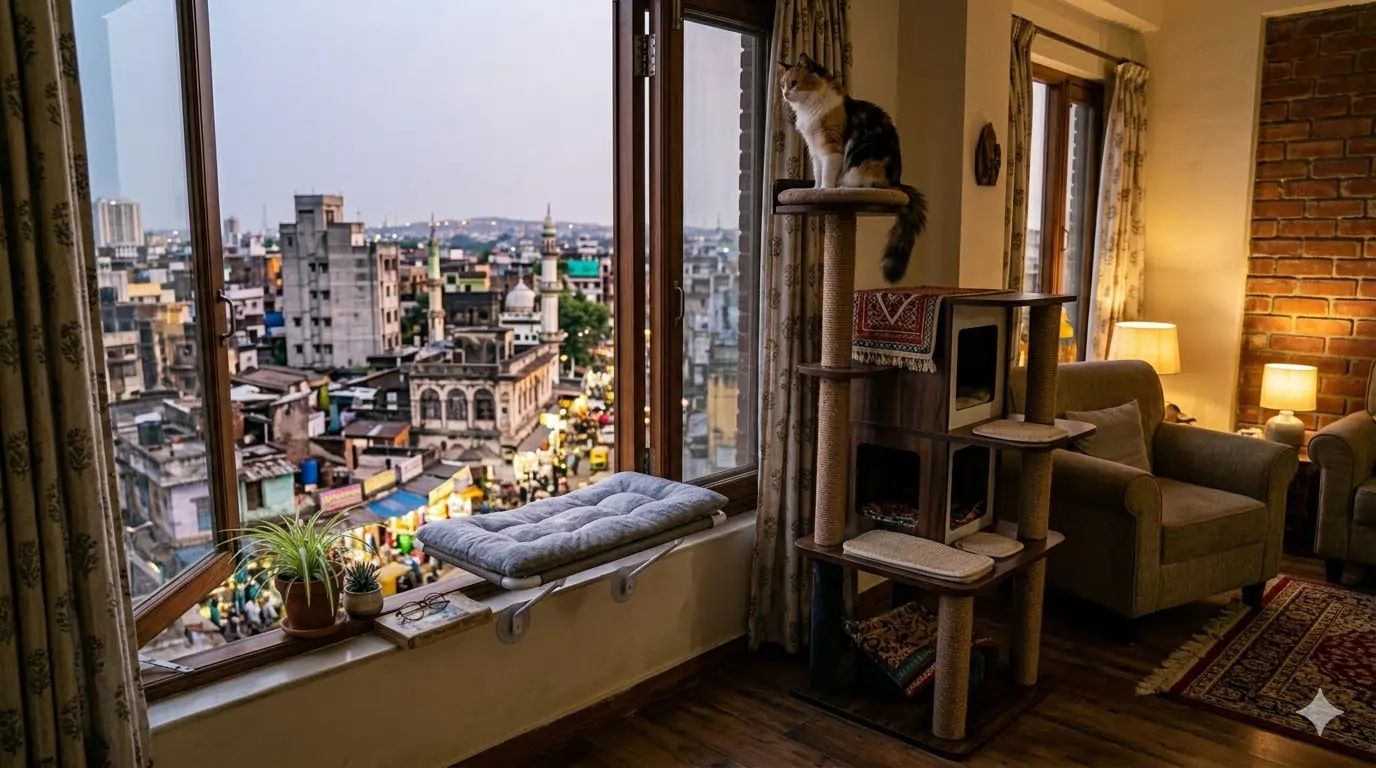 A cat tree that reaches ceiling height effectively creates a second storey for the cat without taking any additional floor space. In a compact Indian apartment, vertical investment is a more efficient use of resources than horizontal expansion.
Indian Home Hazard-Proofing — Specific Risks to Address
Indian apartments have a specific set of hazards that generic cat-proofing guides either miss entirely or mention only in passing. The following are the hazards that most commonly injure or kill cats in Indian apartment settings — not abstract risks but documented, recurring presentations in Indian veterinary clinics.
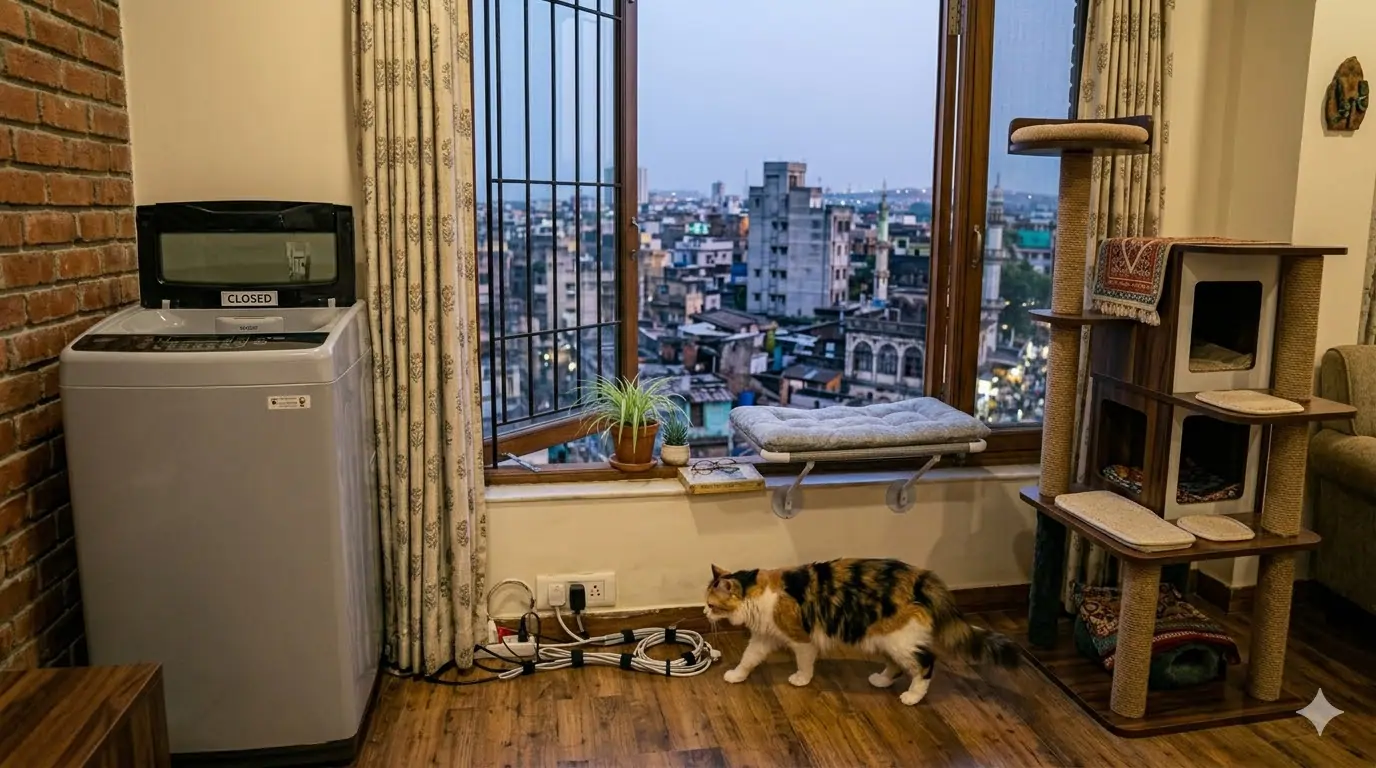 Hazard-proofing an Indian apartment before a cat arrives takes one afternoon and prevents a disproportionate fraction of the emergency vet visits that characterise the first year of cat ownership in Indian homes.
Festival Noise, Fireworks, and High-Traffic Events
The Indian festival calendar is intense. Diwali, Holi, Navratri, Ganesh Chaturthi, and other regional festivals create acoustic and social environments that have no equivalent in the Western contexts where most cat behaviour literature was written. A cat in a Mumbai apartment during Ganesh Chaturthi processions, or in a Delhi flat during the Diwali fireworks window, is experiencing sustained acoustic stress at volumes that are genuinely outside the range for which feline auditory neurology evolved. Cats' hearing range (48 Hz to 85 kHz) and sensitivity mean they experience the same fireworks much more intensely than humans do.
🪔 Diwali — The Highest-Stress Event
The sustained multi-day fireworks window around Diwali (typically two to three days of peak activity) is the most challenging annual period for urban apartment cats in India. Preparation should begin 5–7 days before Diwali: establish the quiet room (a room the cat is already comfortable in, with its bed, water, and a litter box inside); close all windows to reduce sound penetration; apply Feliway Classic spray to the cat's bedding 20–30 minutes before peak fireworks hours; if the cat has a history of significant anxiety, discuss Zylkene (casein hydrolysate — available at Indian veterinary clinics), gabapentin, or trazodone with your vet in advance of the festival — not during it. During peak fireworks: stay calm yourself (cats monitor owner emotional state and are calmed by owner calmness); do not forcibly confine or restrain the cat — let it choose its hiding spot; classical music or white noise played at moderate volume helps mask the fireworks' unpredictability. See the Cat Anxiety & Stress guide for the full protocol.
🎨 Holi — Chemical and Crowd Hazard
Holi poses two distinct risks: chemical exposure from synthetic gulal (coloured powder containing heavy metals, industrial dyes, and mica in cheap formulations) that the cat may walk through and ingest during grooming; and the elevated social activity that brings visitors, noise, and open doors that create escape risk. Keep the cat in a closed room for the duration of outdoor Holi play. If indoor Holi celebration occurs in the home, the cat should be in a room that is entirely protected from the coloured powder — it cannot be cleaned from a cat coat without repeated bathing, and the quantities ingested during grooming can cause GI irritation and potential toxicity depending on the specific dye chemistry.
🥁 Navratri, Durga Puja, and Processions
Extended nights of loud music from speakers near housing societies are a sustained low-level stress event rather than an acute one. The most practical management is ensuring the cat has consistent access to its quiet room throughout the 9–10 day period; maintaining normal feeding times (routine reduces stress response); and monitoring for stress-related health events — Feline Idiopathic Cystitis (FIC) is frequently triggered by sustained environmental stress and may present as straining in the litter box during festival seasons. A male cat that appears to be attempting to urinate without producing urine during or after a stressful festival event should be seen by a vet same day — urethral obstruction is a life-threatening emergency.
🏠 Regular High-Traffic Events — Puja, Parties, Guests
Many Indian households have regular high-footfall events — weekly family gatherings, regular puja ceremonies, annual celebrations that bring many people through the home. The key preparation for each event is consistent: the cat's retreat room is prepared and accessible before guests arrive; guests are briefed not to search for the cat, not to force interaction, and not to open the retreat room; children in the visiting group are supervised and introduced to cat interaction rules. A cat that disappears when guests arrive and re-emerges when they leave is exhibiting normal self-management behaviour — not shyness that needs to be corrected. Let the cat control its own social interactions.
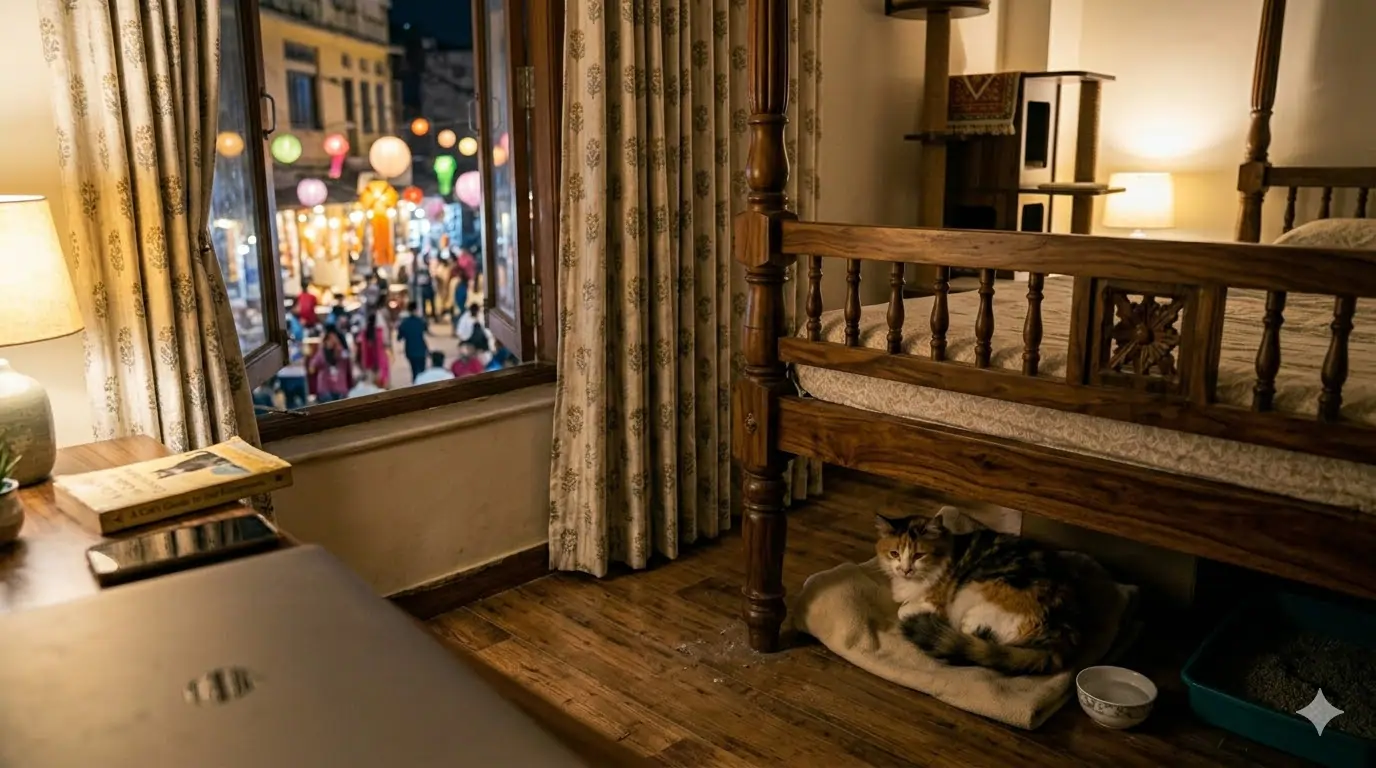 A cat that hides during Diwali or other loud festival events is demonstrating sensible self-regulation. The correct response is to ensure the hiding space is always accessible, stocked with water, and respected by all household members — not to coax the cat out of it.
Multi-Generational Household Dynamics
The joint family and multi-generational household is a structural feature of Indian domestic life that has no real equivalent in the nuclear-family-centred Western cat care literature. A cat in an Indian joint family home may share its space with grandparents who have never had a pet animal indoors, parents who are its primary caretakers, children of various ages, and visiting extended family who may have views about cats ranging from mild curiosity to active dislike. Managing this successfully requires explicit communication and agreed household rules — not hoping that everyone will intuitively understand the cat's needs.
Making Balconies Safe — Not Off-Limits
The balcony is frequently the richest sensory environment available to an Indian apartment cat — fresh air, birdsong, outdoor smells, wind, and visual stimulation from the street below. Permanently blocking balcony access removes a significant source of enrichment. The goal is not to eliminate balcony access but to make it safe — eliminating the fall risk while preserving the sensory access.
-
1
Install catnet before the cat comes home. Butterfly net or dedicated catnet installation is the standard solution for Indian apartment balconies. Catnet is UV-stabilised nylon mesh that encloses the entire balcony opening, including the gap between the floor and the railing base, and the space above the railing to the ceiling or slab above. Catnet installation services operate in most major Indian cities and typically charge ₹1,500–4,000 per balcony depending on size. The net is nearly invisible from inside and does not significantly affect the view or ventilation. This is a one-time installation that lasts 3–5 years with basic care.
-
2
Check the gap below and between railings. Indian apartment balcony railings vary widely in design — some have horizontal bars with gaps wide enough for a cat to push through if excited or startled. Before relying on railings alone for any containment, physically check whether an adult cat can fit through the widest gap. A cat's skull is approximately the same width as its shoulders — if the skull fits, the cat can follow. Any gap wider than approximately 7–8 cm (the approximate skull width of a typical domestic cat) should be fitted with additional mesh or catnet panels.
-
3
Address summer balcony surface heat before every outdoor session. Concrete and tile balcony surfaces reach temperatures sufficient to cause paw pad burns during peak summer hours (see Summer Heat guide). Before opening the balcony, check the surface temperature with the back of your hand. If the surface is too hot to hold your hand against comfortably for 5 seconds, it is too hot for a cat's paw pads. Hose down the balcony surface with water to cool it before allowing access, or restrict access to morning and evening sessions during summer months.
-
4
Provide shade and water on the balcony. A shaded corner (shade net, overhanging slab, or a DIY cover) and a water bowl specifically for balcony time means the cat can spend extended periods outdoors without thermal stress. Position plants, a cat-safe grass pot, and the water bowl in the shaded area to encourage use of the coolest zone rather than the sun-exposed area. Refresh the water before every balcony session — water left in a bowl in direct outdoor sun heats rapidly and will not be drunk.
-
5
Watch for stray cats on adjacent balconies. In densely built Indian apartment buildings, a stray cat on a neighbouring balcony is visible and smellable to your indoor cat across a gap of just a few metres. The territorial arousal this triggers can cause your cat to push against the catnet, attempt to exit through gaps, or redirect aggression onto family members (see Body Language guide — redirected aggression pattern). During periods when strays are visible, distract with play inside rather than extended balcony sessions, and consider frosted window film on the relevant glass panel to reduce the visual stimulus.
-
6
Introduce balcony access gradually to new cats. A newly adopted cat that has not previously had outdoor access should not be given unsupervised balcony access in the first 2–4 weeks. Allow supervised sessions first, monitoring the cat's reaction to height, sounds, and smells before transitioning to independent balcony access. Some cats are cautious about heights by temperament; others have no apparent hesitation. Read the individual cat before expanding access.
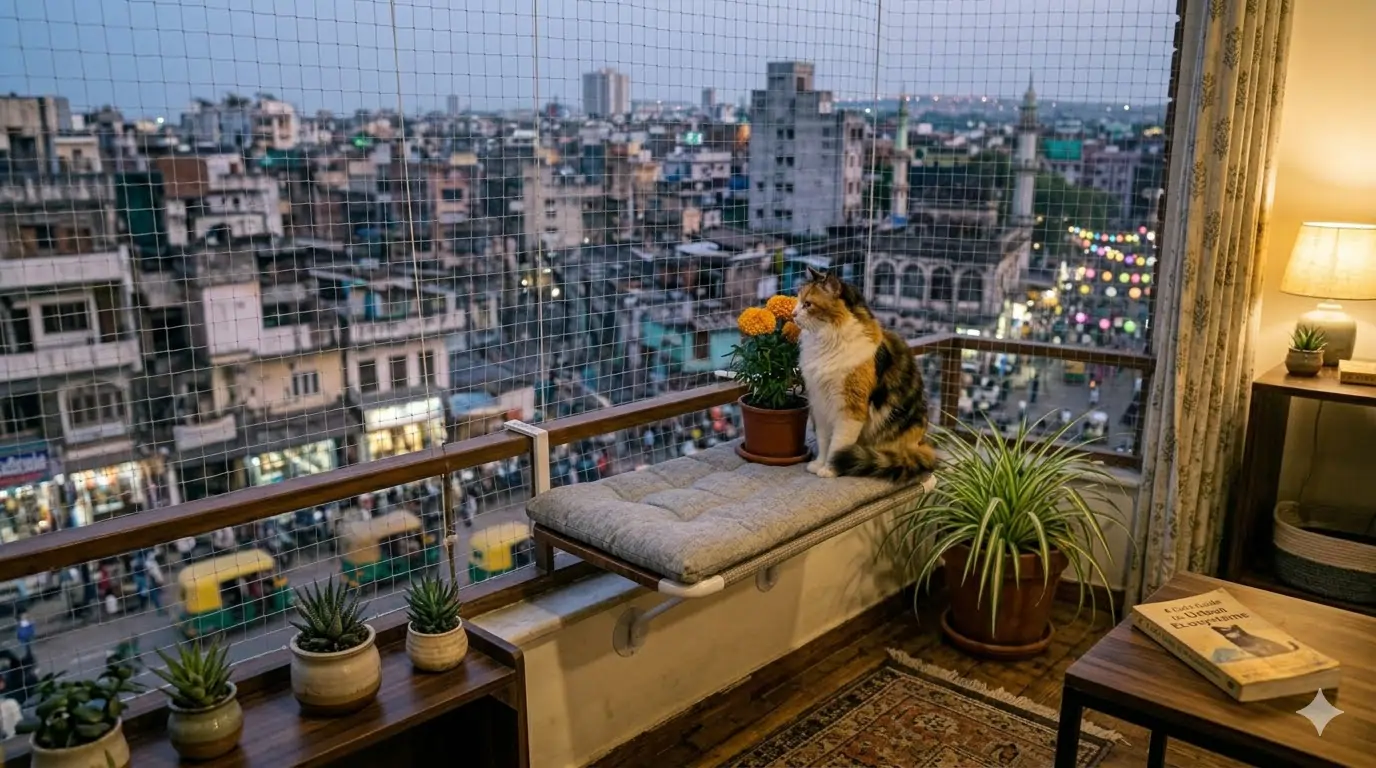 Catnet installation transforms a dangerous high-rise balcony into one of the best enrichment spaces available in an Indian apartment. The net is nearly invisible, does not restrict ventilation, and the installation typically takes under two hours.
Enrichment for the Indoor-Only Apartment Cat
An indoor-only cat in an Indian apartment that lacks adequate enrichment will tell you about it — through furniture destruction, nocturnal vocalisations, attention-demanding behaviour, over-grooming, aggression toward housemates, or a steady drift toward lethargy and weight gain. None of these are signs of a bad cat or a difficult personality. They are signs of a cat whose environment does not meet its cognitive and physical needs. Enrichment is not a luxury — it is preventive veterinary care.
Interactive Play — The Non-Negotiable Daily Minimum
Two play sessions of 10–15 minutes each, every day, using a wand toy or feather toy that simulates prey movement. This is the minimum for an indoor cat — not a luxury extra. Play is the primary outlet for the predatory drive that in an outdoor cat would be directed at actual hunting. Undirected predatory energy accumulates and expresses itself as aggression, destruction, or anxiety. Wand toys (Da Bird, feather wands — available at Indian pet stores and online) allow the owner to simulate prey movement with no substitute. Laser pointers provide initial excitement but leave the cat in a state of permanent frustration because the prey never becomes catchable — end any laser session by landing the light on a physical toy the cat can catch and "kill."
Puzzle Feeders — Cognitive Enrichment at Every Meal
In the wild, a cat spends 4–6 hours per day hunting for the caloric intake that an indoor cat receives in 5 minutes from a food bowl. This is a 95% reduction in cognitive engagement with food procurement. Puzzle feeders — from commercial options (Kong, Catit Senses, available via Amazon.in and pet stores) to DIY options (a muffin tray with kibble in different cups, a toilet roll tube sealed at both ends) — extend the feeding engagement, slow food intake (reducing vomiting from eating too fast), and provide a daily cognitive workout. Rotating between 3–4 different puzzle formats prevents habituation. Even beginning with kibble scattered across a textured mat rather than placed in a bowl produces measurable behavioural improvement.
Rotation of Novel Objects — The "New Thing" Principle
Novelty is intrinsically reinforcing for cats. A new cardboard box, a paper bag with the handles removed, a crinkle tunnel, or a new toy triggers investigation and play behaviour that would not occur with a familiar object. Rather than buying many toys simultaneously and leaving them all out (they become part of the permanent landscape and are ignored), rotate a small collection — keep most items stored and introduce one or two new-or-rotated items every 3–4 days. A cat that ignores the same three toys left out for two months will respond with genuine interest to the same toys reintroduced after a two-week absence. Novelty costs nothing — rotation is the mechanism.
Cat Grass and Olfactory Enrichment
A fresh pot of oat grass or wheatgrass provides texture for chewing, fibre for GI function, and novelty through smell and taste. Replace every 2–3 weeks as it deteriorates. Dried catnip in a sock, valerian-scented toys, or a few drops of silver vine (Actinidia polygama) extract on a toy provide olfactory enrichment that activates a different behavioural response than visual or tactile play — approximately 80% of cats respond to silver vine, compared to 50–70% for catnip, making it worth trying for cats that do not respond to catnip. Rotating olfactory enrichment items weekly prevents habituation.
Visual and Auditory Enrichment
Bird feeders placed outside a window that the cat can view from its perch provide ongoing visual stimulation that requires no owner effort to maintain. In Indian apartments where balcony access is available, a bird feeder positioned so it is visible from the window perch but inaccessible (beyond the catnet) provides hours of daily passive engagement. Nature videos designed for cats — bird and squirrel footage — play well on a tablet or phone placed near a resting spot and are a useful enrichment tool for cats without good window views. Cat music (music composed for cat auditory frequency preferences — available on YouTube and Spotify) provides passive auditory enrichment during alone time.
A Second Cat — The Most Effective Enrichment of All
For an owner who works full-time and whose cat is alone for 8–10 hours daily, a well-matched second cat provides enrichment, social engagement, and allogrooming that no toy or puzzle feeder replicates. The caveat is the word "well-matched" — a second cat introduced without proper protocol can be worse for the resident cat's welfare than remaining alone. A kitten introduced to an adult cat via a 3–4 week gradual introduction protocol (separate rooms, scent swapping, visual introduction before physical contact) has a high probability of forming a compatible bond. An adult cat introduced to another adult without protocol has a significantly higher probability of producing chronic inter-cat tension. See the Kitten Socialisation guide for the introduction protocol.
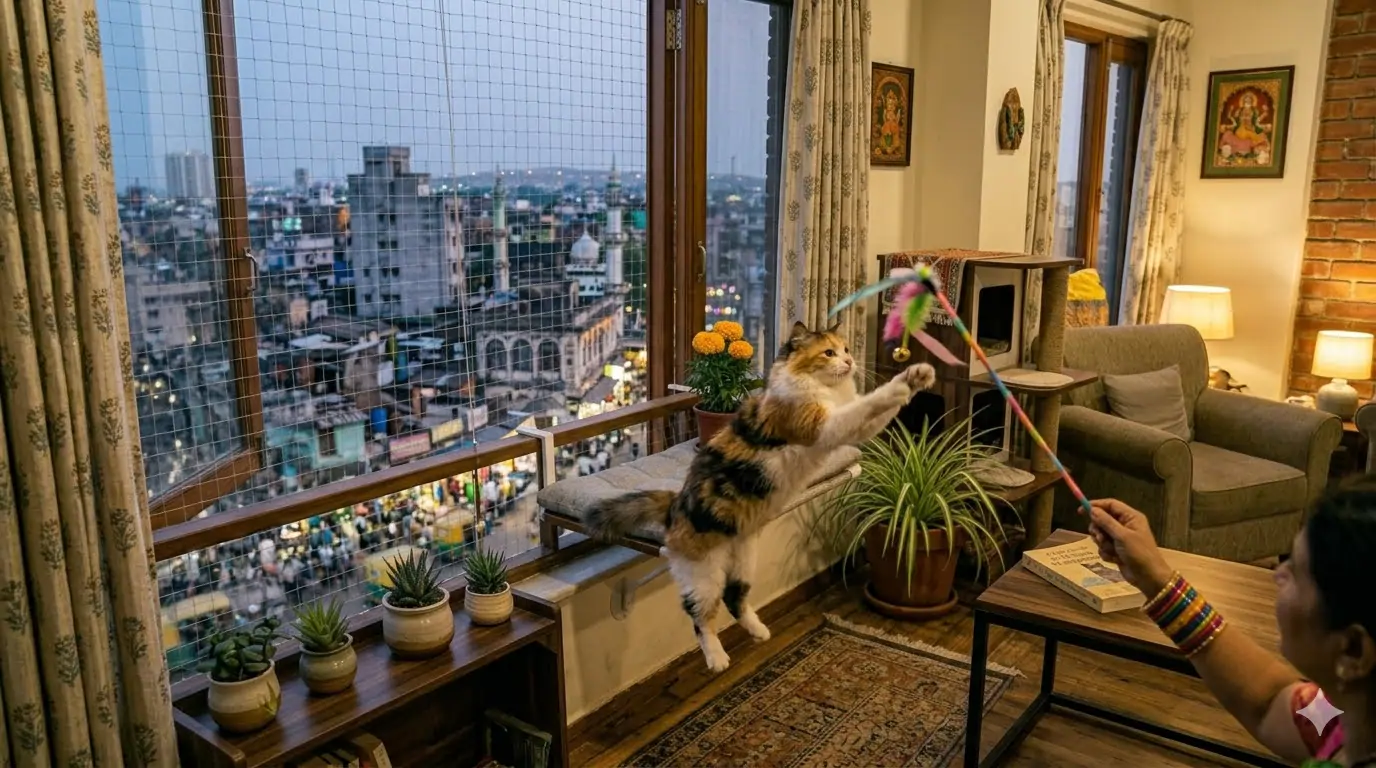 Two 10–15 minute wand-toy play sessions daily address the predatory drive that, in an outdoor cat, would be directed at actual hunting. This single daily practice prevents a disproportionate fraction of the behavioural problems that develop in enrichment-deprived indoor cats.
Renting with a Cat in Indian Cities — Practical Realities
Pet-friendly rental housing is genuinely difficult to find in most Indian cities, and the experience of renting with a cat navigates a set of social, legal, and logistical challenges that have no standard framework in India. The following is a practical guide to the realities, not an idealised account of what the situation should be.
Related Guides
This content is provided for educational purposes only. Phenyl and bleach floor cleaner toxicity information is based on established veterinary toxicology — if your cat has been exposed to phenolic cleaning products and shows signs of illness (drooling, vomiting, weakness, jaundice), contact a veterinarian immediately. Legal information about leases and RWA rules reflects general understanding and is not legal advice — consult a qualified legal professional for guidance specific to your situation and jurisdiction.