
India's mango season (April–July) fills homes with ripe fruit, discarded skins, and large fibrous pits piled in bins and left within easy reach of curious pets. Every year during this period, veterinary clinics across India see a predictable increase in gastrointestinal obstruction cases, pancreatitis flares, and contact dermatitis presentations — many of them mango-related. The fruit itself is not classified as toxic to dogs and cats in the way chocolate or onion is, but the way mango is typically encountered by Indian pets — in large quantities, with skin and pit accessible — creates very real medical emergencies.
Understanding which part of the mango poses which risk, and at what quantity, allows you to make an informed decision about whether and how to share it with your pet. This guide gives you the clinical detail you need to do that safely.

The Four Mango Hazards — Ranked by Severity
🪨 The Pit (Seed) — Obstruction & Amygdalin Toxicity
The mango pit is the most dangerous part by a significant margin. It poses two independent threats: mechanical and chemical.
Mechanical hazard: The pit is large (5–8 cm in many Indian varieties), fibrous, and semi-smooth. It is an ideal size for lodging in the oesophagus of medium-large dogs, and easily causes intestinal obstruction if swallowed. A dog chewing a pit produces sharp, splintered fibrous fragments that can lacerate the oesophagus or perforate the intestinal wall. Small dogs and cats face choking risk at the pit entrance.
Chemical hazard: The mango pit kernel contains amygdalin — a cyanogenic glycoside. When chewed, amygdalin is broken down by gut bacteria into hydrogen cyanide. The quantity in a single pit is unlikely to cause acute cyanide poisoning in a large dog, but it can produce vomiting, weakness, and respiratory distress in small dogs and cats who have consumed pit fragments. It is also a cumulative risk with repeated access.
- Emergency signs: retching without vomiting, abdominal pain, bloating, no stools for 48+ hours
- Action: veterinary emergency immediately — do not wait for symptoms to worsen
🟡 Mango Skin — Urushiol-Like Compounds & Pesticides
Mango belongs to the Anacardiaceae family — the same botanical family as poison ivy, poison oak, and cashew. The skin and sap of the mango contain urushiol-related compounds (particularly in the peel and the tissue just beneath it) that cause contact hypersensitivity reactions in predisposed individuals. In pets, this manifests as:
- Oral and facial contact dermatitis — redness, swelling, hives around the mouth
- Drooling and pawing at the face from mucosal irritation
- Vomiting and diarrhoea from the skin's high fibre, tannin, and irritant content
- Pesticide toxicity — non-organic Indian mangoes carry significant surface pesticide residue (chlorpyrifos, malathion, mancozeb are commonly used on Indian mango crops); even washing does not fully eliminate surface residues
The skin is also a choking hazard in large, intact pieces. Never give mango skin to any pet — the risks provide no nutritional benefit.
🍊 Flesh in Excess — Sugar, Fibre, and Pancreatitis
Ripe mango flesh is not toxic, but it is very high in natural fructose (14–17 g per 100 g) and soluble fibre. In controlled, small amounts, it is unlikely to cause harm in a healthy adult dog. In cats and in any excess quantity, it causes:
- Cats: Cats have no sweet taste receptors and derive no pleasure from fruit. Even small amounts of high-sugar fruit can cause vomiting and diarrhoea — mango is simply not appropriate for cats as a treat
- Pancreatitis: The high sugar and fibre load from a large mango serving triggers pancreatic enzyme release in a way that can precipitate acute pancreatitis in any dog with prior pancreatitis history, overweight dogs, and small terrier breeds prone to the condition (Miniature Schnauzer, Cocker Spaniel)
- Diabetic pets: Even a tablespoon of mango causes a glycaemic spike — absolutely contraindicated in pets with diabetes mellitus
- Weight gain: A single tablespoon of ripe Alphonso mango contains ~15 kcal — for a 5 kg dog whose total daily intake is 300 kcal, this is 5% of daily calories from a single treat
🟢 Unripe (Green) Mango — Acidity & Tannins
Unripe mango is significantly more acidic (malic acid, citric acid, tartaric acid) and contains far higher concentrations of tannins than ripe fruit. Tannins bind to proteins and irritate the gastrointestinal mucosa. In pets:
- Severe gastritis — vomiting with a sour, acidic component
- Oral irritation and hypersalivation
- Diarrhoea with possible blood-streaking from mucosal irritation
Raw mango (kairi) scraps from making panna, chutneys, or pickles should be kept completely away from pets. Raw mango pickles (aam ka achar) add salt, oil, and spices on top of the base risk — pancreatitis in dogs is a near-certain outcome from any significant achar consumption.
Symptoms of Mango-Related Problems
Symptoms vary by which part of the mango was ingested and how much. Some — particularly those suggesting intestinal obstruction — require same-day emergency veterinary care.
What to Do If Your Pet Eats Mango Pit or Skin
- 1Stay calm and assess what was eaten. Note the time, estimate how much was consumed (full pit / partial pit / skin only), and your pet's approximate weight. This information is the first thing your vet will ask for.
- 2Do not induce vomiting at home. A mango pit is large enough that bringing it back up risks oesophageal rupture. A partly-chewed pit with sharp fragments causes additional laceration damage on the way up. Vomiting induction for foreign body ingestion should only be done by a veterinarian with appropriate assessment and monitoring.
- 3Call your veterinarian immediately — even if your pet currently appears well. Intestinal obstruction from a pit can take 24–72 hours to become clinically apparent; by then the bowel wall may already be compromised. Early radiographic assessment gives far better treatment outcomes.
- 4Monitor closely for 72 hours if the vet advises watchful waiting. Check for: eating and drinking normally, normal stool production (critical — note every stool or absence of stool), energy levels, and any abdominal swelling or pain.
- 5Go to emergency vet immediately if any of the following develop: vomiting that won't stop, no stool for 48 hours, visible abdominal distension, severe pain, collapse, pale or blue gums, or rapid breathing.
Safe Ways to Share Mango — If You Choose To
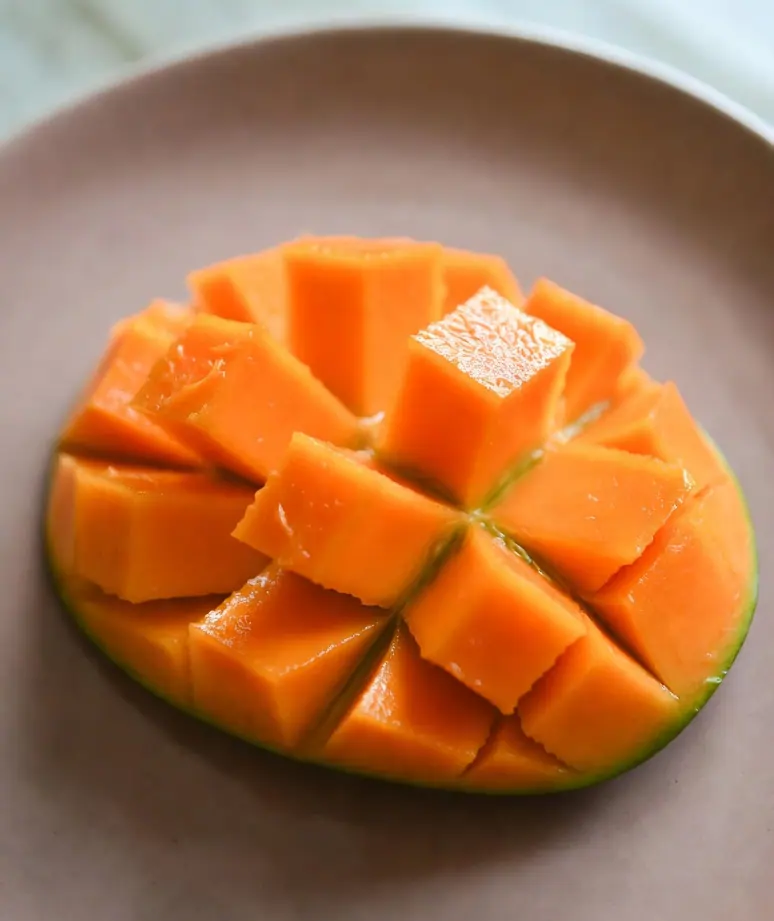
For a healthy adult dog with no history of pancreatitis, diabetes, or digestive disease, a very small amount of ripe mango flesh — correctly prepared — is unlikely to cause harm. Cats should generally not be given mango; they derive no nutritional benefit and their digestive systems are poorly adapted to high-fructose fruit.
| Pet Size / Type | Maximum Single Serving | Frequency | Notes |
|---|---|---|---|
| Toy/small dog (<5 kg) | 1 teaspoon (2–3 small pieces) | Once or twice a week maximum | Monitor for diarrhoea closely; pancreatitis prone breeds — avoid entirely |
| Medium dog (5–15 kg) | 1 tablespoon | Once or twice a week maximum | Count calories — 1 tbsp Alphonso mango ≈ 15–18 kcal |
| Large dog (15–40 kg) | 2–3 tablespoons | Once or twice a week maximum | Never after a fatty meal — combined pancreatic load increases risk |
| Cat (any size) | 1 pea-sized piece | Rare — not recommended | Cats gain nothing nutritionally; most will show GI upset; skip it |
| Diabetic pet | None | Avoid entirely | High fructose causes glycaemic disruption |
| Pancreatitis history | None | Avoid entirely | High sugar + fibre = pancreatic trigger; risk not worth benefit |
India-Specific Mango Season Precautions
Related Guides
This content is provided for educational purposes only and is not a substitute for professional veterinary advice. If your pet has ingested a mango pit, a significant quantity of skin, or any large amount of mango flesh — contact your registered veterinarian or nearest animal emergency clinic immediately. Do not wait for symptoms to develop. Intestinal obstruction from a pit can be fatal without prompt treatment.